





What's Happening?
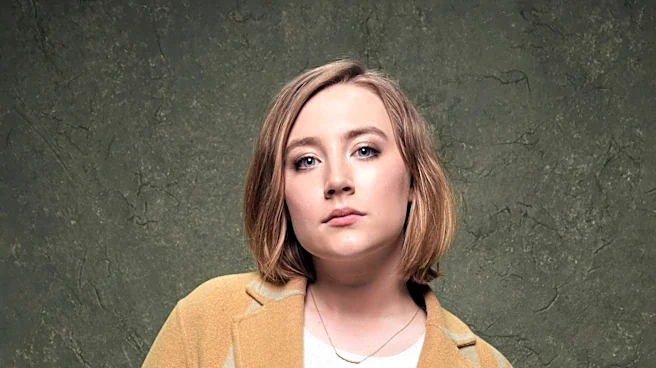
The name of Irish actress Saoirse Ronan remains a significant challenge for British pronunciation, according to a recent analysis of Google search data. Her first name, along with other Irish female names like Aoife, Niamh, and Caoimhe, consistently ranks
among the words British people struggle most to pronounce. This year, 'Saoirse' placed third in Google pronunciation searches, with 'Aoife' coming in second. The word game website unscramblerer.com, which conducted the survey, provides guidance on these pronunciations, though with varying degrees of accuracy from an Irish perspective. For instance, 'Niamh' is often suggested as 'Neev,' which is considered incomplete by most Irish speakers, and 'Caoimhe' is given as 'Kee-va,' while 'Kwee-va' is more common in other regions of Ireland. This trend highlights a persistent linguistic hurdle for many in the UK when encountering Irish names.
Why It's Important?
The ongoing difficulty in pronouncing Irish names, particularly those of prominent figures like Saoirse Ronan, underscores a broader cultural and linguistic gap. While seemingly minor, the consistent mispronunciation can lead to a sense of othering or a lack of recognition for individuals and their heritage. For public figures, it can be a recurring point of discussion, drawing attention to their name rather than their work. The high volume of Google searches for these pronunciations, with Saoirse alone garnering 163,000 searches this year, indicates a public desire to learn, suggesting a potential for greater cultural understanding. However, the persistence of these challenges, even after centuries of interaction between Ireland and Britain, highlights the deep-seated nature of linguistic differences and the slow pace of their assimilation.
What's Next?
The trend of Irish names posing pronunciation challenges is likely to continue, given their unique phonetic structures compared to English. While resources like pronunciation guides from websites like unscramblerer.com offer assistance, their effectiveness can be limited by regional variations in pronunciation within Ireland itself. The increased visibility of Irish culture and individuals on a global stage, particularly through entertainment, may gradually lead to greater familiarity and improved pronunciation over time. However, without a more concerted effort in education or media to accurately represent and teach these pronunciations, the 'missionary work' of Irish names in the UK, as described by the source, will likely remain a slow process. The ongoing evolution of AI and automated subtitle technology also presents a potential avenue for improvement, though current systems still demonstrate significant inaccuracies.
Beyond the Headlines
The persistent struggle with Irish names extends beyond mere linguistic difficulty; it touches upon historical and cultural dynamics. The article subtly references the historical relationship between Ireland and Britain, noting that 'considering it was an Aoife MacMurrough whose marriage brought them over here in the first place, and 856 years later they still can’t say her name, it’s hard to be confident.' This historical context suggests that the issue is not just about phonetics but also about a deeper, perhaps unconscious, cultural disconnect. The absence of Irish male names from these lists of difficult pronunciations also raises questions about gendered perceptions and the specific challenges faced by Irish women's names in a broader cultural landscape. This linguistic phenomenon, therefore, serves as a small but telling indicator of ongoing cultural assimilation and recognition challenges.