





What's Happening?
Aerospacelab, which is rebranding as Ectro on November 30, has opened its new 215,000 sq ft satellite production facility, the Megafactory, in Charleroi, Belgium. This facility, described as Europe's largest satellite manufacturing facility, is designed
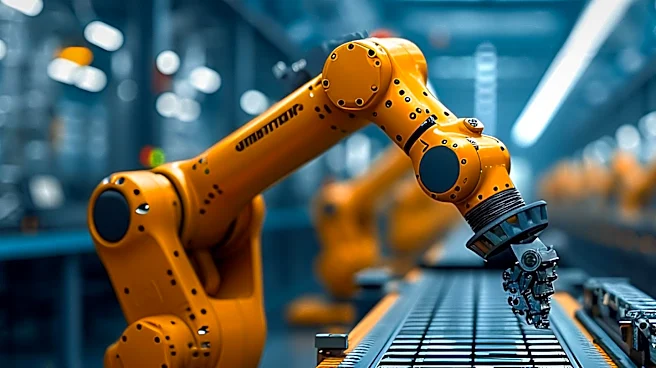
to produce up to 500 satellites annually and is expected to reach full production capacity next year. The company is shifting from manufacturing individual satellites to an assembly line model capable of building hundreds of satellites and thousands of components. This expansion comes as Europe increases its national and commercial constellations. Aerospacelab recently secured a €2.4 billion contract to design, manufacture, and deliver 264 low Earth orbit satellites for the European Commission's IRIS2 secure communications constellation, representing over three-quarters of the total 348-satellite fleet. This contract marks a significant achievement for a European startup in a sector traditionally dominated by established aerospace and defense primes.
Why It's Important?
This development signifies a major shift in the European space sector, demonstrating increased trust in startup companies for large-scale, critical projects. The Megafactory's capacity to produce hundreds of satellites and thousands of components annually addresses a growing demand for space infrastructure, particularly for secure communication networks. The €2.4 billion IRIS2 contract awarded to Aerospacelab challenges the traditional dominance of large aerospace and defense contractors, indicating a more efficient and competitive market where factors like pace, quality, price, and performance are gaining prominence, even in public orders. This could lead to greater innovation and cost-effectiveness in satellite manufacturing, benefiting both governmental and commercial entities reliant on satellite technology. The focus on component-level manufacturing also highlights the critical role of supply chains in scaling satellite production, potentially fostering a more robust and localized European space industry.
What's Next?
Aerospacelab's immediate focus will be on proving its capability to complete the IRIS2 project on time and within budget, a challenge that has historically faced larger, more established companies. The company anticipates significant recurring business from IRIS2 for replenishment and expects other countries within and outside the EU to allocate budgets for their own constellations, building on the IRIS2 model. This suggests a busy five-year outlook for Aerospacelab. The company also aims to maintain its culture of transparency and proactive customer engagement while scaling up, balancing the agility of a NewSpace entity with the demands of legacy customers. The long-term state of the industry, particularly regarding customer consolidation and vertical integration, remains a key question, but Aerospacelab is positioning itself to support these evolving market dynamics, especially at the component level.
Beyond the Headlines
The success of Aerospacelab in securing such a substantial contract and rapidly expanding its manufacturing capabilities could serve as a blueprint for other European startups seeking to disrupt established industries. It underscores a broader trend of decentralization and increased competition in sectors traditionally dominated by a few large players. The emphasis on localized production and robust supply chains also reflects a growing geopolitical awareness regarding strategic independence in critical technologies. Ethically, the shift towards more efficient and potentially more affordable satellite production could democratize access to space-based services, impacting global communication, Earth observation, and scientific research. However, it also raises questions about the long-term sustainability of such rapid expansion and the potential for market saturation or consolidation among a new generation of 'neo-primes.'