










What's Happening?
Rivian, an electric vehicle manufacturer, has initiated an underwritten public offering of 75 million shares of common stock, aiming to raise approximately $1.5 billion. This move comes shortly after Rivian's stock experienced a significant rally due
to better-than-expected second-quarter delivery results and an optimistic full-year outlook. The offering, announced on July 6, 2026, includes a 30-day option for underwriters to purchase an additional 11.25 million shares. The funds raised will be used for general corporate purposes, including fulfilling equity contributions related to an amended loan agreement with the U.S. Department of Energy. The offering is managed by major financial institutions such as Goldman Sachs and J.P. Morgan, under a shelf registration effective since April 30, 2026.
Why It's Important?
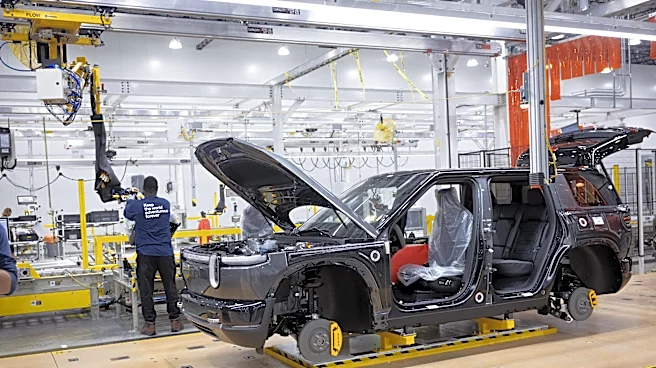
This capital raise is crucial for Rivian as it seeks to scale up production of its R2 SUV, a more affordable midsize vehicle, which began deliveries in June 2026. The funds will support Rivian's expansion efforts, particularly at its Georgia factory, where production capacity is planned to increase significantly. However, the share offering results in approximately 6% dilution for existing shareholders, which has led to an 11% drop in Rivian's stock price in pre-market trading. Despite the dilution, the strategic timing of the offering allows Rivian to capitalize on recent stock gains, providing necessary financial resources to advance its production goals and meet obligations under its DOE loan.
What's Next?
Rivian's immediate focus will be on utilizing the raised capital to enhance its production capabilities and meet its delivery targets. The company aims to increase its annual production capacity at the Georgia plant to 300,000 vehicles, which will include the R2 and future models. The success of this expansion is critical for Rivian to achieve positive gross margins and long-term financial stability. Investors and industry analysts will be closely monitoring Rivian's ability to execute its production plans and manage the financial implications of the share dilution.