





What's Happening?
Bayonne Drydock & Repair Corp. in New Jersey has received a $673,123 federal grant to modernize its shipyard operations. The grant, championed by Congressman Rob Menendez, was awarded through the U.S. Department of Transportation’s Maritime Administration
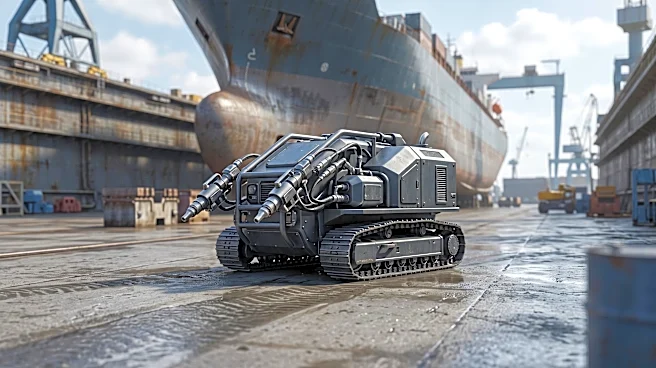
(MARAD) Small Shipyard Grant Program. This funding, combined with the company's own investment, will facilitate the purchase of an American-made ultra-high-pressure hydro-blasting and surface-preparation system. This new technology utilizes remotely operated robotic crawlers, aiming to replace manual hand-lancing, reduce reliance on rented equipment, and enhance the efficiency of hull-preparation jobs. The company anticipates a reduction of over 40% in labor hours for typical hull-preparation tasks. The project also includes a second unit, spare parts, and training for the company's more than 300 employees to operate and maintain the new equipment. This investment follows previous MARAD grants to Bayonne Drydock, including $1.08 million in 2018 and $730,477 in 2023.
Why It's Important?
This federal grant is significant for several reasons, primarily impacting the U.S. maritime industry and local economy in New Jersey. The modernization of Bayonne Drydock's facilities through advanced robotic technology will improve operational productivity and reduce downtime, which is crucial for maintaining national maritime readiness. The shipyard supports government vessels, including those connected to Military Sealift Command, MARAD’s Ready Reserve Force, and the U.S. Coast Guard. By strengthening these capabilities, the grant contributes to national security and defense infrastructure. Furthermore, the investment supports skilled maritime jobs in New Jersey by providing employees with training on state-of-the-art equipment. The shift from manual labor to robotic systems also signifies a broader trend towards automation in industrial sectors, potentially setting a precedent for other shipyards. This initiative helps ensure the Port of New York and New Jersey remains a competitive and efficient hub for marine repair services.
What's Next?
The immediate next steps for Bayonne Drydock involve the procurement and implementation of the new ultra-high-pressure hydro-blasting and surface-preparation system. This will be followed by comprehensive training for its workforce to ensure proficient operation and maintenance of the advanced robotic technology. The company expects to see a significant reduction in labor hours for hull-preparation jobs, leading to improved turnaround times for vessel repairs. This modernization is part of an ongoing effort by Bayonne Drydock to enhance its productivity and strengthen its role in the regional maritime industry. Future developments may include further federal investments in similar modernization projects across U.S. shipyards, as the MARAD Small Shipyard Grant Program continues to support eligible facilities. The success of this implementation could also encourage other shipyards to adopt similar robotic solutions to improve efficiency and competitiveness.
Beyond the Headlines
Beyond the immediate benefits of increased efficiency and job training, this investment highlights the critical role of federal grants in bolstering the U.S. industrial base and national defense capabilities. The focus on American-made equipment underscores a broader national strategy to support domestic manufacturing and reduce reliance on foreign supply chains. The adoption of robotic technology in a traditional industry like shipbuilding also raises questions about the evolving nature of skilled labor and the need for continuous workforce adaptation. While automation can increase efficiency, it also necessitates upskilling existing employees and potentially reshaping future job roles. This development could serve as a model for how federal funding can drive technological advancement and economic resilience in key sectors, ensuring that U.S. infrastructure remains competitive and capable of meeting both commercial and governmental demands.