




What's Happening?
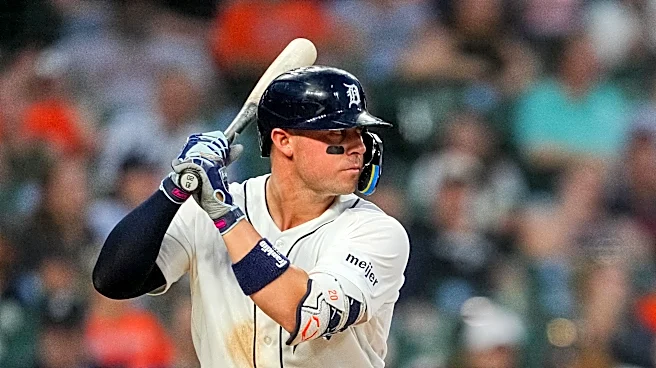
The Detroit Tigers are confronting a significant decision regarding Spencer Torkelson, a former No. 1 overall draft pick, as the MLB non-tender deadline approaches on November 20. Torkelson is currently under contract through 2028, and CBS Sports writer
Mike Axisa projects his 2027 salary to be $7.7 million. Despite his high draft pedigree, Torkelson has not consistently delivered the impact hitting expected, exhibiting a high strikeout rate, middling on-base percentages, and a lack of secondary value in defense or baserunning. The Tigers must decide whether to offer him a contract for the upcoming season or non-tender him, which would make him an immediate free agent. While non-tendering a former No. 1 pick is rare, the team is weighing Torkelson's production against his projected salary. The absence of an obvious replacement first baseman, with Colt Keith serving as a backup in 2026, complicates the decision.
Why It's Important?
This decision holds significant implications for the Detroit Tigers' roster construction and financial strategy. Retaining Torkelson at a projected $7.7 million for 2027, and potentially higher in 2028 through arbitration, represents a substantial investment in a player whose performance has been inconsistent. If the Tigers choose to non-tender him, they would free up salary space but also lose a player with No. 1 pick potential, albeit unrealized. This move could signal a shift in the team's development philosophy or a more aggressive approach to managing player salaries based on performance. Conversely, keeping Torkelson provides continuity at first base, even if his offensive output is not elite, and allows for further development. The outcome will influence the team's payroll flexibility and their ability to pursue other talent in the free-agent market or through trades, directly impacting their competitiveness in future seasons.
What's Next?
The Detroit Tigers must make their final decision on Spencer Torkelson by the non-tender deadline on November 20. If they offer him a contract, Torkelson will remain with the team, and negotiations for his 2027 salary will proceed, likely through arbitration if an agreement isn't reached. Should the Tigers non-tender him, Torkelson would immediately become a free agent, allowing him to sign with any other MLB team. This scenario would compel the Tigers to actively seek a new first baseman, either through trades, free agency, or by promoting an internal option like Josué Briceño, though the source indicates Briceño is not yet ready for the major leagues. There is also a possibility of a trade involving Torkelson before the non-tender deadline, offering the Tigers an alternative way to manage his future with the team.
Beyond the Headlines
The situation with Spencer Torkelson highlights the inherent risks and complexities in MLB's draft and player development system, particularly for high-round picks. The pressure on former No. 1 overall selections to perform at an elite level is immense, and when that potential isn't fully realized, teams face difficult choices between financial prudence and the hope of future breakout performance. This decision also reflects broader trends in baseball analytics, where player value is increasingly scrutinized against salary expectations and alternative options. The Tigers' choice will not only impact their immediate roster but also serve as a case study for how teams manage highly-touted prospects who struggle to meet initial expectations, potentially influencing future draft strategies and player contract negotiations across the league. It underscores the challenge of balancing long-term investment with short-term performance demands in professional sports.