




What's Happening?
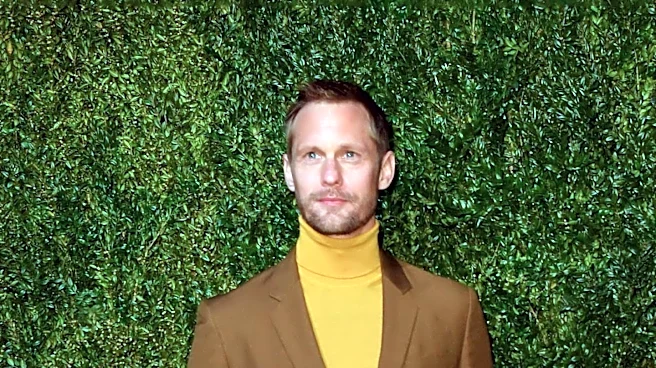
Prosthetics master Joe Dunckley has revealed the intricate process behind creating Alexander Skarsgård's 'wicker' costume for the film 'Wicker.' Contrary to appearances, the costume did not involve actual wicker. Instead, Dunckley explained in an interview
with Variety that the character's woven look was achieved through 3D printing and painting effects. These effects were then stitched onto a spandex suit worn by Skarsgård. The material used was a semiflexible thermoplastic elastomer, which was fused using a laser to build intricate weave and complex geometry. Skarsgård, who co-stars with Olivia Colman in the film, previously discussed the costume on 'The Graham Norton Show,' noting that it took 18 months to create and was made by artists who worked on 'Lord of the Rings.'
Why It's Important?
This detailed explanation of the 'Wicker' costume highlights the advanced techniques and artistry employed in modern filmmaking, particularly in practical effects. The use of 3D printing and specialized materials demonstrates how technology is pushing the boundaries of costume design, allowing for highly realistic and complex character transformations without relying solely on CGI. This approach can enhance the immersive experience for audiences and offers filmmakers greater creative control over visual elements. For the film industry, it underscores the value of skilled prosthetics artists and the significant investment in time and resources required to achieve such detailed practical effects, potentially influencing future production decisions regarding special effects budgets and artistic direction.
What's Next?
The success and critical reception of the practical effects in 'Wicker' could encourage more filmmakers to explore similar advanced prosthetics and costume design techniques in future productions. This might lead to a greater demand for specialized artists and technologies in the film industry. Audiences, now aware of the intricate details behind such creations, may develop a deeper appreciation for the craftsmanship involved in practical effects. The film's innovative approach to costume design could also inspire new trends in theatrical and cinematic productions, pushing the boundaries of what is achievable through physical effects rather than purely digital ones.
Beyond the Headlines
The creation of Skarsgård's 'wicker' costume touches upon broader themes of authenticity and immersion in storytelling. In an era dominated by digital effects, the commitment to practical effects, even with advanced technologies like 3D printing, speaks to a desire to maintain a tangible connection with the physical world of the film. This approach can contribute to a more visceral and believable experience for viewers, fostering a deeper emotional engagement with the characters and narrative. It also raises questions about the evolving definition of 'practical effects' as technology advances, blurring the lines between traditional craftsmanship and cutting-edge innovation in the pursuit of artistic vision.