







What's Happening?
The Bank of Japan (BOJ) has revised upward its economic assessment for two of the country's nine regions in its latest quarterly report, while maintaining its assessment for the remaining regions. The central bank's report, compiled during a meeting of its regional
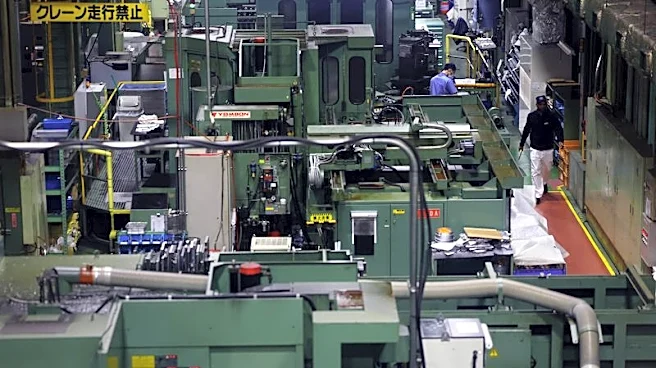
branch managers in Tokyo, highlighted strong demand related to artificial intelligence (AI), particularly for semiconductor manufacturing equipment and electronic components. The BOJ specifically raised its economic assessment for the Tohoku northeastern region, moving from an economy that 'has been picking up' to one that 'has been recovering moderately.' Similarly, the Shikoku western region's economic view was upgraded from 'has been picking up moderately' to 'has been picking up.' Across all nine regions, the BOJ noted that the economy has been 'picking up moderately,' 'recovering moderately,' or 'on a moderate recovery trend,' though it acknowledged 'some weakness has been seen in part.' An electrical equipment manufacturer in Osaka reported that AI-related demand is increasing faster than anticipated and is expected to remain robust for approximately the next three years.
Why It's Important?
This upgrade in economic assessment by the Bank of Japan, driven by robust AI-related demand, signals a significant trend that could have ripple effects on global technology and manufacturing sectors, including those in the U.S. Strong demand for semiconductor manufacturing equipment and electronic components in Japan indicates a healthy and expanding AI industry, which relies heavily on advanced hardware. U.S. companies involved in semiconductor production, AI software development, and related supply chains stand to benefit from this sustained growth. Conversely, it could intensify competition for critical components and talent, potentially affecting U.S. firms' production costs and market strategies. The sustained demand for AI-related products also underscores the increasing global integration of AI into various industries, suggesting a long-term shift in economic drivers. For U.S. policymakers, this trend highlights the importance of maintaining technological leadership and securing supply chains for critical AI components to ensure continued economic competitiveness.
What's Next?
The Bank of Japan's continued monitoring of regional economies will provide further insights into the sustainability and breadth of AI-driven growth. Future reports will likely detail whether this strong demand translates into broader economic recovery across more regions or if it remains concentrated in specific sectors. Companies, both within Japan and internationally, particularly those in the U.S., will be closely watching for sustained investment in AI infrastructure and manufacturing capabilities. This could lead to increased cross-border collaborations, mergers, and acquisitions in the technology sector. Furthermore, the robust demand for AI components may prompt governments to re-evaluate and potentially strengthen policies related to technological innovation, intellectual property protection, and supply chain resilience. The next few years are expected to see continued expansion in AI-related industries, influencing investment decisions and strategic planning for businesses worldwide.
Beyond the Headlines
The Bank of Japan's assessment points to a deeper transformation in the global economy, where artificial intelligence is becoming a primary engine of growth. This shift has profound implications beyond immediate economic indicators. Ethically, the rapid advancement and deployment of AI raise questions about job displacement, data privacy, and algorithmic bias, which will require careful consideration and policy responses from governments and international bodies. Legally, the increasing complexity of AI technologies will necessitate new regulatory frameworks for intellectual property, liability, and international data governance. Culturally, the integration of AI into daily life could alter societal norms, human-computer interaction, and the nature of work itself. For the U.S., understanding and adapting to these long-term shifts will be crucial for maintaining its competitive edge and addressing the broader societal challenges and opportunities presented by the AI revolution.