







What's Happening?
A new study suggests that a global coalition of countries implementing carbon pricing across four key industrial sectors—iron, steel, aluminum, cement, and fertilizers—could significantly reduce greenhouse gas emissions and generate substantial public
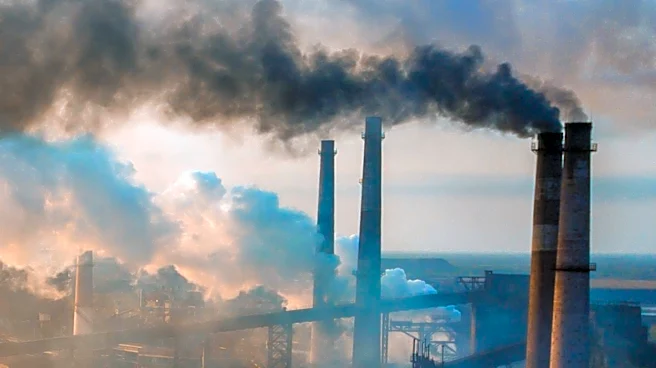
revenue. These four industries collectively account for approximately 20% of global greenhouse gas emissions. The proposed coalition would involve member countries introducing carbon pricing for these sectors and applying carbon charges to imports from non-member countries. This approach aims to address 'carbon leakage,' where companies relocate production to countries with weaker climate policies, and the 'free-rider' problem, where some nations benefit from global emission reductions without contributing equally. Catherine Wolfram of the Massachusetts Institute of Technology (MIT), a lead researcher on the project, emphasized that this coalition model offers a practical path to overcome international climate-policy coordination challenges by aligning incentives and building on existing efforts.
Why It's Important?
This initiative holds significant importance for the U.S. and global efforts to combat climate change. For U.S. industries in the specified sectors, participation in such a coalition could mean adapting to carbon pricing mechanisms, potentially increasing operational costs in the short term but fostering innovation in cleaner production methods. Conversely, non-participation could lead to carbon border adjustments on U.S. exports to coalition members, impacting competitiveness. Economically, the generation of nearly $200 billion in annual public revenue globally could provide funds for further climate initiatives or other public services. Politically, the U.S. joining such a coalition would signal strong commitment to climate action and could influence other major economies to follow suit, strengthening international climate policy. The framework also offers a solution to the long-standing issue of carbon leakage, ensuring that climate efforts are not undermined by companies seeking less stringent environmental regulations elsewhere, thereby creating a more level playing field for environmentally responsible businesses.
What's Next?
The study's findings are likely to fuel discussions among policymakers, industry leaders, and environmental organizations regarding the feasibility and implementation of such a climate coalition. Countries, including the U.S., will need to evaluate the economic and political implications of joining or forming such an alliance. This could involve detailed analyses of carbon pricing mechanisms, trade policies, and their impact on domestic industries and international competitiveness. Negotiations and diplomatic efforts would be required to establish the framework for such a coalition, including agreements on carbon price levels and border adjustment mechanisms. The proposal for differentiated carbon prices based on countries' income levels suggests a pathway for broader participation, which will be a key consideration in future discussions. The success of this initiative would depend on significant international cooperation and a willingness to overcome existing barriers to coordinated climate action.
Beyond the Headlines
The concept of a 'climate coalition' with carbon pricing and trade policies delves into the deeper implications of global economic restructuring driven by environmental imperatives. It highlights a shift from purely voluntary climate agreements to more integrated economic and trade policies designed to enforce environmental standards. This approach could fundamentally alter global supply chains and industrial practices, pushing industries towards greater sustainability. Ethically, it raises questions about equitable burden-sharing between developed and developing nations, which the study attempts to address through differentiated carbon pricing. Legally, the implementation of carbon border adjustments could face challenges under existing international trade laws, necessitating new legal frameworks or interpretations. Culturally, it represents a growing recognition that environmental protection is not just an ecological issue but an economic and geopolitical one, requiring systemic changes in how goods are produced, traded, and consumed globally. This coalition model could set a precedent for future international cooperation on other global challenges, demonstrating how economic incentives can be leveraged for collective good.