







What's Happening?
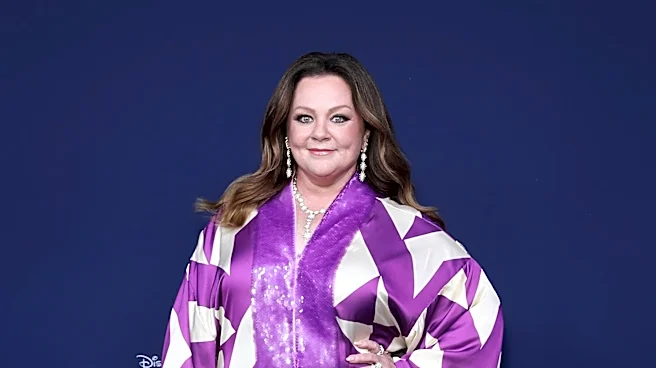
Melissa McCarthy has voiced her disappointment regarding the absence of a sequel to her 2015 action-comedy film 'Spy,' which also starred Jason Statham and Jude Law. Despite the film's critical acclaim and box office success, grossing over $230 million
worldwide, a follow-up has not materialized. McCarthy believes that Hollywood's changing business model is to blame, suggesting that studios are no longer interested in producing comedies of that scale, even if they are profitable. She noted that 'everyone' involved in 'Spy' was ready for a sequel, and director Paul Feig had even begun developing ideas for one. McCarthy argues that while her films may not gross billions, they consistently make a healthy profit, and she struggles to understand why this model is no longer favored by studios.
Why It's Important?
Melissa McCarthy's comments highlight a significant shift in the Hollywood landscape, particularly concerning the production of mid-budget comedies. Her frustration underscores a broader industry trend where studios increasingly prioritize tentpole blockbusters and franchise films over original or moderately successful comedies. This shift has profound implications for actors, writers, and directors specializing in the comedy genre, potentially limiting opportunities for diverse storytelling and character-driven narratives. For the entertainment industry, it raises questions about the long-term viability of certain film genres and the economic models that drive production decisions. The reluctance to greenlight sequels for profitable films like 'Spy' suggests a risk-averse environment where only projects with the highest potential for massive returns are pursued, potentially stifling creative innovation and audience choice. This trend could lead to a less diverse cinematic offering and impact the careers of many talented individuals in Hollywood.
What's Next?
The ongoing debate about the future of mid-budget comedies in Hollywood is likely to continue, with more industry figures potentially echoing McCarthy's sentiments. Studios may face increasing pressure from creators and audiences to diversify their production slates and reconsider the value of profitable, albeit not billion-dollar, films. While a 'Spy 2' remains unlikely in the immediate future, the discussion could influence future investment decisions in the comedy genre. Filmmakers and actors might explore alternative distribution channels, such as streaming services, which may be more open to producing a wider range of content. This situation could also lead to a re-evaluation of what constitutes 'success' in the film industry, moving beyond purely astronomical box office numbers to include factors like critical reception, audience engagement, and consistent profitability.
Beyond the Headlines
Beyond the immediate concerns of film production, McCarthy's observations delve into deeper cultural and economic implications within the entertainment industry. The shift away from mid-budget comedies reflects a broader cultural trend towards spectacle and escapism in media consumption, potentially at the expense of more nuanced or character-driven storytelling. Economically, it highlights the increasing financial pressures on studios to deliver massive returns, leading to a homogenization of film offerings. This trend could have long-term effects on the development of comedic talent and the evolution of the genre itself, as fewer opportunities arise for experimentation and growth. Ethically, it raises questions about the industry's responsibility to provide diverse content that caters to a wide range of audience preferences, rather than solely focusing on the most lucrative, often formulaic, productions. The 'math of it,' as McCarthy puts it, suggests a cold, analytical approach to art that may ultimately diminish its cultural value.