


What's Happening?
Xpeng, a Chinese automaker, announced that its robotics unit has successfully raised over $900 million in its initial funding round. This achievement marks a new record for a single private financing in China's embodied AI sector. The funding round was
spearheaded by IDG Capital and received support from strategic investors such as Tencent and Alibaba. Gaorong Ventures, an early investor in autonomous driving and humanoid robot startups, also participated. This significant investment has propelled the robotics business's valuation to more than $6.3 billion. The proceeds from this funding will be allocated towards advancing robotics hardware and software development, refining physical AI models, collecting high-quality data, establishing mass-production facilities, and facilitating global expansion efforts. Xpeng's CEO, He Xiaopeng, has personally taken the lead in the robotics business, underscoring the company's commitment to mass production in this sector.
Why It's Important?
This record-breaking funding round for Xpeng's robotics unit highlights the increasing global interest and investment in the embodied AI and humanoid robot sectors. The substantial capital infusion will enable Xpeng to accelerate its technological advancements and production capabilities, potentially positioning it as a leader in the burgeoning robotics market. For the U.S., this development signifies the rapid progress of international competitors in advanced technological fields, particularly in AI and robotics. It could spur increased investment and innovation within the U.S. tech industry to maintain competitiveness. The eventual commercialization and global expansion of Xpeng's humanoid robots could introduce new dynamics to various industries, including manufacturing, logistics, and retail, by offering advanced automation solutions. U.S. businesses and policymakers will need to monitor these advancements closely to understand their implications for labor markets, technological standards, and economic competitiveness.
What's Next?
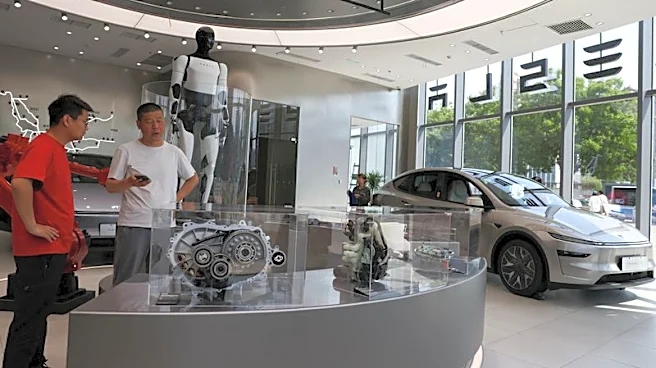
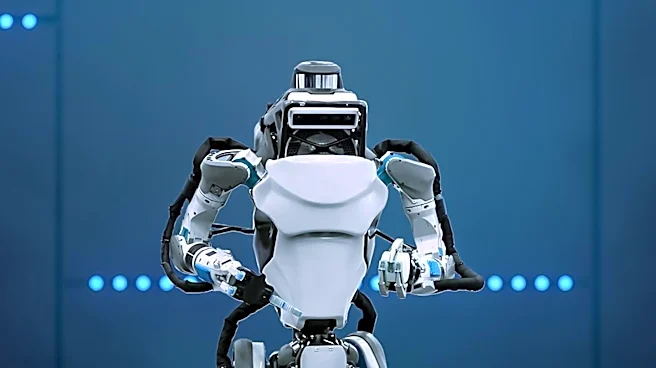
Xpeng has outlined ambitious plans for its IRON humanoid robot, aiming to achieve a monthly output of 1,000 units by the end of the current year. Initial deployments are slated for Xpeng's retail stores and industrial campuses. The company anticipates commencing commercial sales and deliveries in both China and overseas markets starting in 2027. This timeline suggests a rapid transition from development to market availability, indicating a significant push towards integrating humanoid robots into practical applications. The success of these initial deployments and commercial sales will be crucial in determining the broader adoption and impact of Xpeng's robotics technology. Other automakers and tech companies are likely to observe Xpeng's progress closely, potentially influencing their own investment and development strategies in the robotics sector. The global expansion plans also suggest future competition in international markets, including those relevant to U.S. businesses.
Beyond the Headlines
The substantial investment in Xpeng's robotics unit underscores a broader trend of convergence between the automotive and robotics industries. Automakers are increasingly leveraging their expertise in sensors, software, batteries, and supply-chain management to venture into robotics, recognizing parallels with intelligent vehicle development. This cross-industry synergy could lead to accelerated innovation and the creation of highly sophisticated robotic systems. The ethical and societal implications of widespread humanoid robot deployment, particularly concerning labor displacement and human-robot interaction, will become increasingly pertinent. As these technologies advance, discussions around regulatory frameworks, safety standards, and the responsible development of AI will gain prominence. The competition in the embodied AI sector, as evidenced by other significant funding rounds like TARS Robotics, indicates a global race to dominate this transformative technology, with long-term impacts on economic structures and daily life.