







What's Happening?
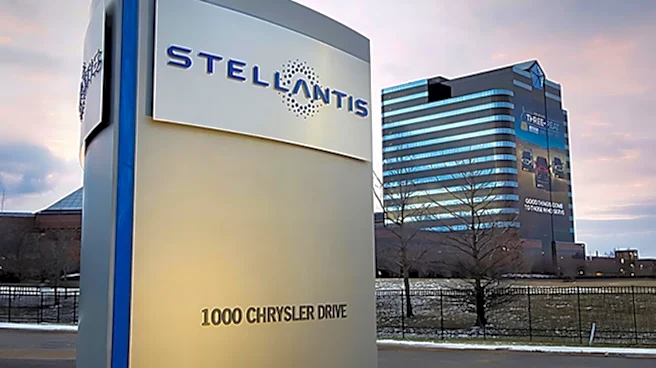
Stellantis, the automotive group behind brands like Jeep, Ram, Chrysler, Dodge, and Maserati, is developing AI-driven Level 2++ supervised automated driving technology with a target launch in North America by 2028. This initiative aims to bring advanced
AI driving assistance into mainstream vehicles. The technology, a collaboration with British developer Wayve, combines Wayve AI Driver for environmental interpretation and driving decisions with Stellantis' STLA AutoDrive platform. Demonstrations have already taken place in Fiat 500e, Maserati Grecale, and Jeep Grand Cherokee development vehicles, showcasing the system's ability to manage lane positioning, speed, and changing traffic situations on various roads, including urban routes. Unlike traditional driver-assistance systems that rely on predefined rules, Wayve's approach uses end-to-end embodied artificial intelligence, learning patterns from driving data to interpret complex road conditions. This adaptability across different vehicle types and sensor configurations is crucial for broader implementation.
Why It's Important?
This development is significant for American drivers as it promises to expand advanced driving assistance beyond luxury vehicles and into a wider range of mainstream models. The ability of the AI system to interpret entire scenes and adapt to varying road conditions, including urban environments, could substantially reduce the cognitive load on drivers during everyday journeys. By leveraging a common AI foundation, Stellantis aims to make sophisticated driver-assistance features more practical and potentially more affordable to produce, which could lead to wider adoption. However, the distinction between supervised Level 2++ driving and fully autonomous driving is critical; drivers will still need to continuously monitor the road. The success of this technology will depend on Stellantis' ability to prove its reliability in difficult or unusual road conditions and to clearly communicate its capabilities and limitations to consumers, impacting public trust and safety perceptions of AI in vehicles.
What's Next?
Stellantis is targeting a 2028 launch for its Wayve-powered hands-free supervised driving system in North America. While development vehicles have demonstrated the technology, the company has not yet announced which specific U.S. production models will receive the system first, nor has it detailed pricing, subscription charges, or hardware requirements. Future steps will involve rigorous testing to ensure the system's reliability and safety across diverse driving scenarios, especially in challenging weather or unexpected road conditions. Clear communication to consumers regarding the system's operational limits and the driver's responsibility will be paramount. The company's strategy also involves expanding its relationship with Qualcomm for Snapdragon Digital Chassis computing technology and Snapdragon Ride Pilot, and incorporating Mobileye's cloud-enhanced driver-assistance technology in selected vehicles by 2027, indicating a multi-faceted approach to advanced driver assistance.
Beyond the Headlines
The introduction of AI-driven Level 2++ supervised automated driving by Stellantis raises deeper implications regarding the evolution of human-machine interaction in vehicles and the regulatory landscape. The concept of 'Level 2++' highlights the ongoing challenge of categorizing and communicating the capabilities of advanced driver-assistance systems, potentially leading to consumer confusion if not clearly defined. The shift from rule-based systems to AI that learns from data introduces new ethical and legal considerations, particularly concerning accountability in the event of system failures or accidents. Proving the reliability of AI decisions in unpredictable real-world scenarios will be a significant hurdle, requiring robust testing and validation frameworks. This development also underscores a broader industry trend towards integrating AI across various vehicle segments, potentially democratizing access to advanced safety and convenience features, but also necessitating a re-evaluation of driver training and public education on these evolving technologies.