






What's Happening?
Ontario Power Generation (OPG) has announced that its Darlington Small Modular Reactor (SMR) project, intended to be the first of its kind in Canada, is experiencing significant delays and cost overruns. The project will miss its initial target for commercial
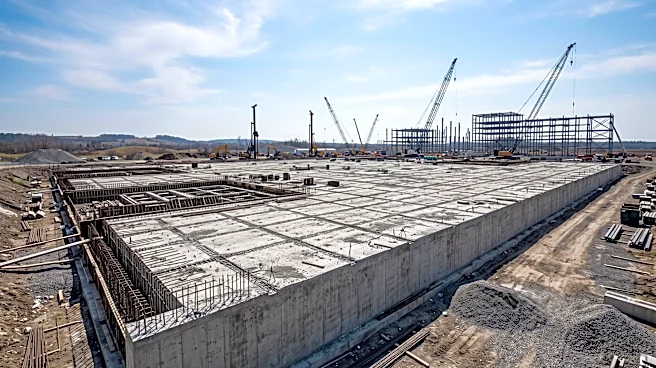
operation in October 2030, and the current budget estimate of $7.7 billion Canadian is expected to be exceeded. A comprehensive review of the project's cost and schedule is underway, with substantial completion anticipated by mid-2027. The primary issue stems from the reactor supplier, GE Vernova Hitachi, which is still finalizing engineering work. This incomplete design has subsequently impacted construction planning and coordination within the supply chain. Despite these challenges, on-site construction has progressed, including the placement of a 2.1 million-pound concrete basemat. However, physical progress does not mitigate the uncertainties arising from the upstream design issues, highlighting the complexities inherent in first-of-a-kind industrial projects.
Why It's Important?
The challenges faced by the Darlington SMR project have significant implications for the broader nuclear energy sector, particularly for the development and deployment of SMR technology. SMRs are promoted as a more predictable and cost-effective method for building nuclear infrastructure due to their standardized designs and repeatable construction processes. However, the delays and budget increases at Darlington underscore the inherent risks and learning curves associated with the initial deployment of any new technology. This situation could influence investor confidence and public perception regarding the viability and economic competitiveness of SMRs as a solution for clean energy. For contractors and developers considering similar first-of-a-kind nuclear projects, the Darlington experience serves as a critical case study, emphasizing the importance of design maturity and robust supply chain management before committing to project timelines and budgets. The project's outcome will likely shape future strategies for nuclear energy development in North America and beyond.
What's Next?
The immediate next step for the Darlington SMR project is the completion of a comprehensive review of its cost and schedule, which is expected by mid-2027. This review will provide a revised timeline and budget, offering more clarity on the project's future trajectory. Stakeholders, including government bodies, energy providers, and potential investors, will closely monitor these revised projections to assess the project's feasibility and economic implications. The ongoing engineering work by GE Vernova Hitachi will need to be finalized to allow for more predictable construction planning and supply chain coordination. The project's progress will also be watched by other nations and companies exploring SMR deployment, as the lessons learned from Darlington could inform their own strategies. Future developments will likely focus on how effectively OPG and its partners can mitigate the current design and supply chain challenges to bring the project to fruition, albeit on a revised schedule and budget.
Beyond the Headlines
The issues at the Darlington SMR project extend beyond immediate financial and scheduling concerns, touching upon the fundamental promise of small modular reactors. The concept of SMRs hinges on the idea that modularity and standardization will lead to reduced costs and faster deployment compared to traditional large-scale nuclear plants. However, the Darlington experience suggests that the 'first-of-a-kind' premium for SMRs can still be substantial, challenging the notion of immediate cost predictability. This raises questions about the true economic advantages of SMRs in their initial deployments and how quickly the industry can achieve the promised cost reductions through repeatability. Furthermore, the project highlights the critical importance of design maturity in complex industrial undertakings. Incomplete engineering can create cascading problems throughout the construction and supply chain, undermining the very benefits that modular designs are intended to deliver. The long-term success of SMR technology will depend on the industry's ability to effectively manage these initial learning curves and translate theoretical advantages into practical, cost-effective energy solutions.