






What's Happening?
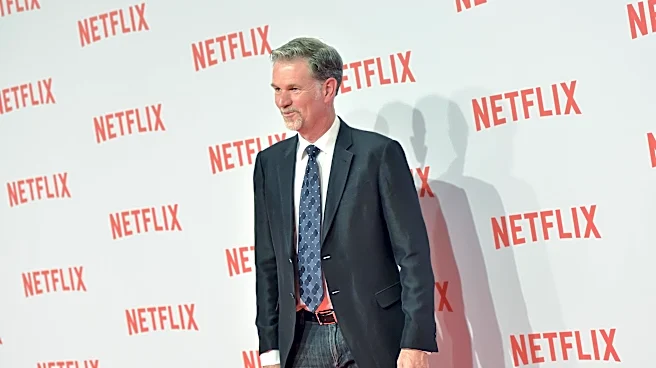
Reed Hastings, co-founder, former CEO, and current chairman of the board at Netflix, believes that the ongoing artificial intelligence (AI) revolution could lead to a renewed emphasis on the humanities as a field of study. Hastings, who studied AI and computer
science in the 1980s, shared this perspective decades after his initial engagement with the technology. His insights come from a background deeply rooted in technological innovation, having co-founded Netflix in 1997, initially as a DVD-rental service. This view suggests a potential shift in educational and societal priorities as AI continues to advance and integrate into various aspects of life. The discussion around AI's impact often centers on technological and economic changes, but Hastings's perspective highlights a less explored cultural and educational consequence.
Why It's Important?
This perspective from a prominent tech leader like Reed Hastings is significant because it challenges the prevailing narrative that technological advancements, particularly in AI, might diminish the value of humanities. Instead, Hastings suggests a symbiotic relationship where AI's rise could necessitate a deeper understanding of human culture, ethics, and critical thinking—skills traditionally fostered by the humanities. This could influence educational institutions to re-evaluate curricula, potentially leading to increased funding and enrollment in humanities programs. For the U.S. workforce, a renewed focus on humanities could cultivate a generation of professionals better equipped to navigate the ethical and societal implications of AI, fostering innovation that is not only technologically advanced but also human-centric. It also implies a potential shift in how industries perceive and value diverse skill sets, moving beyond purely STEM-focused hiring to include individuals with strong backgrounds in critical analysis and cultural understanding.
What's Next?
Should Hastings's prediction gain traction, it could spark broader discussions within academic and industry circles about the future of education and workforce development. Universities might begin to explore interdisciplinary programs that blend AI and humanities, preparing students for a future where technological proficiency is complemented by ethical reasoning and cultural awareness. Policy makers could also consider initiatives to support humanities education, recognizing its potential role in shaping a responsible AI-driven society. Furthermore, tech companies might start to prioritize hiring individuals with diverse educational backgrounds, including those with humanities degrees, to address the complex challenges posed by AI development and deployment. This shift could lead to a more holistic approach to technological innovation, ensuring that AI serves broader societal goals.
Beyond the Headlines
The deeper implication of Hastings's statement lies in its potential to reframe the societal value of the humanities in an increasingly technology-dominated world. For years, there has been a perceived decline in the relevance of humanities degrees, often overshadowed by the demand for STEM fields. However, if AI automates many technical tasks, the unique human capacities for creativity, critical thinking, ethical judgment, and understanding complex social dynamics—all cultivated by the humanities—will become even more indispensable. This could lead to a cultural renaissance where the arts, philosophy, history, and literature are seen not as luxuries but as essential tools for navigating an AI-powered future. It also raises questions about the ethical frameworks necessary for AI development, suggesting that humanistic inquiry will be crucial in preventing unintended consequences and ensuring AI aligns with human values.