







What's Happening?
Economist Ren Zeping, known for his predictions regarding China's A-share bull market, has been subjected to a gag order on his WeChat social media accounts. Since October 24, his official WeChat account, 'Zeping Macro,' and his WeChat video account have
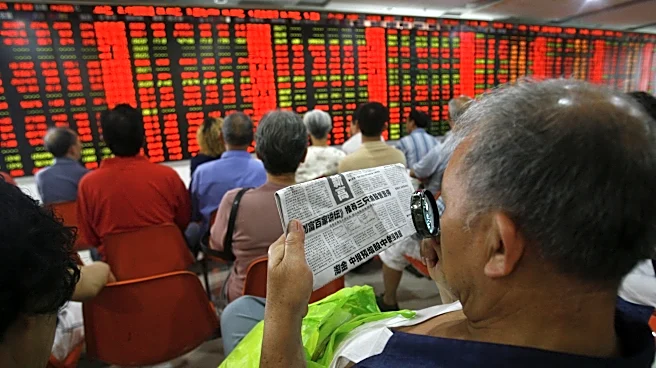
been inaccessible via search and are no longer accepting new subscribers. Attempts to follow these accounts result in a system message indicating that they are 'blocked from new followers over rule violations.' Support staff for the platform have described the account status as 'abnormal' but stated that the specific cause for the restrictions remains 'unknown' to them. This development comes amidst a bear market in China's stock exchanges and follows Ren Zeping's recent 'buy the dip' recommendation.
Why It's Important?
This incident highlights the significant control that social media platforms, particularly those operating within China, can exert over public discourse and financial commentary. For U.S. investors and businesses with interests in the Chinese market, such actions underscore the potential for sudden and opaque restrictions on information flow. The silencing of a prominent economist, even if the specific reasons are undisclosed, can create an environment of uncertainty and impact market sentiment. It also raises questions about the reliability of information available through these channels and the potential for censorship to influence investment decisions. The lack of transparency regarding the 'rule violations' further complicates the assessment of risk and opportunity in the Chinese economic landscape.
What's Next?
The immediate future for Ren Zeping's WeChat accounts remains uncertain, as the platform has not provided a clear explanation for the gag order. It is possible that the restrictions could be temporary or permanent, depending on the nature of the alleged 'rule violations.' This event may lead to increased scrutiny from international observers regarding freedom of speech and economic commentary within China. For other economists and financial commentators operating on Chinese social media platforms, this incident could serve as a cautionary tale, potentially leading to self-censorship or a more cautious approach to market analysis. The broader implications for the Chinese stock market and investor confidence will depend on how such incidents are perceived and addressed by both the platforms and regulatory bodies.
Beyond the Headlines
The gag order on Ren Zeping's WeChat accounts extends beyond a simple platform restriction; it touches upon the delicate balance between economic commentary and state control in China. In a market often influenced by sentiment and official narratives, the ability to freely express dissenting or even contrarian views is crucial for a healthy and transparent financial ecosystem. This incident could be interpreted as a move to manage public perception during a challenging economic period, particularly given the 'buy the dip' call amidst a bear market. It also underscores the broader trend of increasing digital authoritarianism, where online platforms are used as tools to control information and shape public opinion, with potential long-term consequences for global financial transparency and the free flow of economic data.