
What's Happening?
In 1993, IBM faced a severe financial crisis, reporting a net loss of $8.1 billion, an increase from $4.965 billion in 1992. The company was struggling with a declining mainframe market, organizational
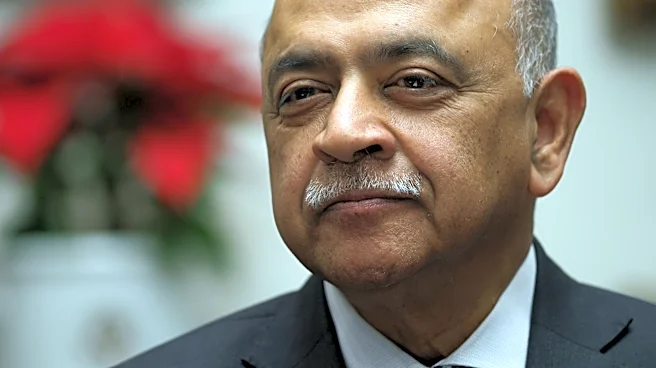
fragmentation, and high costs. Amid discussions about breaking up its various product businesses, newly appointed CEO Louis V. Gerstner Jr., who took office in April 1993, made a pivotal decision. Contrary to the prevailing trend of streamlining and breaking up large corporations, Gerstner chose to keep IBM intact, focusing instead on integrating technology and enterprise services as the company's core value. This decision was met with debate, as Gerstner lacked a deep background in computer product development, having previously worked at American Express and RJR Nabisco. However, his contribution was not in inventing new technology but in redefining what the company should offer by aligning product organization with customer needs. This strategic pivot aimed to leverage IBM's global technology, services, and customer relationships to provide comprehensive solutions that competitors could not easily match.
Why It's Important?
Gerstner's decision to integrate IBM rather than break it apart had profound implications for the company's future and set a precedent for corporate strategy in the technology sector. At a time when many believed that breaking up large, struggling corporations into smaller, more agile units was the only path to survival, IBM's approach demonstrated the potential value of a unified entity capable of offering integrated hardware, software, and services. This strategy allowed IBM to transition from a product-centric model to a service-oriented one, addressing complex customer problems with holistic solutions. The shift enabled IBM to generate new revenue streams from consulting, long-term contracts, and ongoing maintenance, fundamentally changing its economic model. This move was critical in transforming IBM from a company facing massive losses to one that eventually saw its services revenue surpass hardware sales by 2001, highlighting the importance of understanding customer needs for integrated solutions rather than just individual products.
What's Next?
The long-term impact of Gerstner's strategy continued to unfold in the years following his initial decision. IBM continued to adjust its business portfolio, eventually selling its PC division and investing heavily in enterprise services, software, and infrastructure. This demonstrated that while the initial decision was to 'not break up,' it did not mean all businesses would be retained indefinitely. Companies can maintain integrated governance while divesting or acquiring product lines based on market cycles. For current AI infrastructure companies, IBM's historical experience offers a crucial lesson: as technology complexity increases, the question arises whether companies should be broken into smaller units based on products or build cross-technology stack management capabilities. Gerstner's choice suggests the latter, provided that enterprises are willing to pay for integrated capabilities, rather than relying solely on the perceived advantages of a large organization.
Beyond the Headlines
The strategic choice made by IBM under Gerstner highlights a fundamental tension in corporate governance: whether to pursue specialization through divestiture or leverage synergy through integration. This decision was not merely financial but also philosophical, challenging the prevailing wisdom of the time. The success of IBM's integration strategy underscored that the value proposition for enterprise customers often lies in comprehensive, seamlessly integrated solutions rather than disparate components. This approach also necessitated a significant internal transformation, requiring IBM to eliminate internal redundancies, adjust product offerings, and integrate management information systems to refocus its capabilities on marketable services. The case of IBM serves as a powerful example of how a company can redefine its core identity and business model in response to market shifts, emphasizing that strategic integration, when executed effectively, can be a potent tool for revitalization and sustained growth.