







What's Happening?
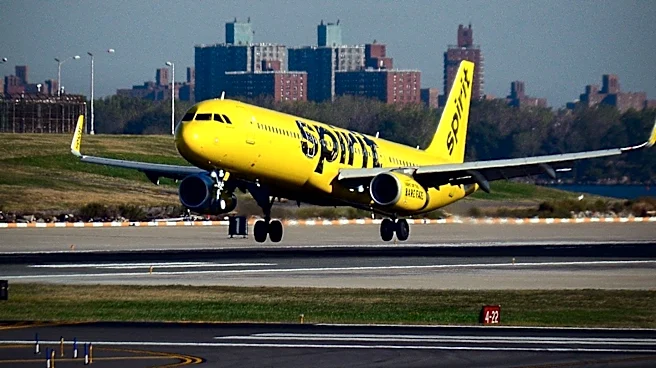
Comcast and its subsidiaries, Masergy and Nitel, have filed a claim in bankruptcy court seeking $1.25 million from the defunct Spirit Airlines for unpaid internet services. Spirit Airlines ceased operations on May 2, 2025, due to an inability to secure
further funding. The internet providers assert that some services continued to run even after Spirit filed for bankruptcy on August 29, 2025. Their November 19 court filing requests the bankruptcy judge to mandate payment and compel Spirit to decide on keeping or rejecting the contracts. While some of the claimed charges date back to locations Spirit reportedly vacated in 2024, the providers argue that Spirit has not produced records proving service cancellation. The total amount claimed by Comcast Cable Communications Management is $219,743.41, Masergy Cloud Communications $164,626.99, Masergy Communications $849,646.45, and Nitel $11,990.73.
Why It's Important?
This case highlights the complexities of bankruptcy proceedings, particularly concerning ongoing service contracts and the prioritization of creditors. If the internet providers successfully argue that their services were necessary for the administration of Spirit's bankruptcy estate, these claims could be classified as administrative expenses, granting them priority over other unsecured debts. This prioritization is crucial for businesses that continue to supply services to bankrupt entities, as it incentivizes their cooperation during the unwinding process. Conversely, if the court determines that the services were not beneficial to the bankruptcy estate, especially for locations Spirit was no longer using, Comcast and its subsidiaries might have to join the ranks of other unsecured creditors, potentially facing significant delays or reduced recovery of their claims. The outcome could set a precedent for how essential services are treated in future airline bankruptcies.
What's Next?
A hearing on this matter is scheduled for December 16, with responses due by December 9. The bankruptcy judge will need to determine whether the internet services provided by Comcast and its subsidiaries qualify as administrative expenses, which would grant them priority payment. Even if the claim is granted administrative priority, immediate payment is not guaranteed, as seen in previous cases like Midway Airlines, where administrative creditors had to wait for payment alongside others. The court will also need to assess the benefit of these services to the bankruptcy estate, particularly for connections that Spirit was no longer actively using. The resolution of this dispute will impact the final distribution of Spirit Airlines' remaining assets among its creditors.
Beyond the Headlines
This situation underscores the critical importance of meticulous contract management and clear communication during corporate shutdowns and bankruptcy. Spirit Airlines' alleged failure to formally cancel internet services for vacated locations has created a significant financial liability post-cessation of operations. For businesses, this serves as a stark reminder to ensure all service contracts are properly terminated and documented, even in the face of a complete shutdown. For service providers, it highlights the challenges of recovering debts from bankrupt entities and the strategic importance of seeking administrative expense status for ongoing services. The case also touches upon the broader legal framework governing bankruptcy, where the definition of 'necessary expenses' can be a point of contention, influencing the financial recovery prospects for various stakeholders.