

What's Happening?
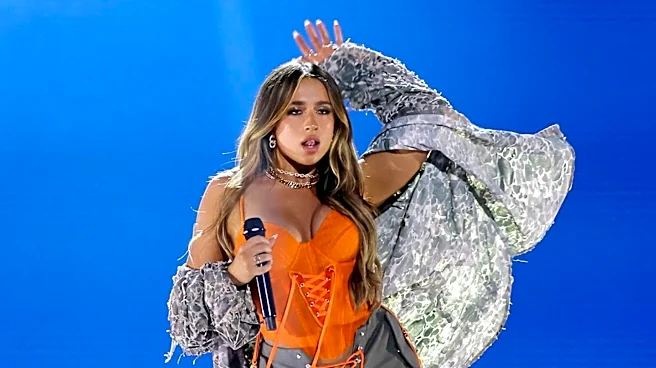
Tate McRae, a pop artist, has spoken out regarding the criticism she received for her duet with country singer Morgan Wallen, titled 'What I Want.' In an interview with W Magazine, McRae addressed the backlash, which included accusations from some fans
of being 'MAGA' due to her association with Wallen. While Wallen's fanbase generally welcomed the collaboration, many of McRae's followers expressed outrage. McRae has previously stated that her involvement was 'just about the song' and that her political stance is 'pretty obvious.' She highlighted that it is 'crazy to think that one song could define a whole person' and that there are many aspects of her personality unknown to a large portion of her audience. Wallen has not publicly discussed his personal political beliefs, leading to assumptions about his leanings.
Why It's Important?
This situation underscores the increasing pressure on artists to align their professional collaborations with their perceived political or social views, and the potential for fan bases to project political identities onto musicians. The backlash against Tate McRae for her duet with Morgan Wallen illustrates how artistic choices can be interpreted through a political lens, even when artists assert their focus is purely on music. This trend can limit creative freedom and cross-genre collaborations, as artists may become hesitant to work with others who have different fan demographics or perceived political affiliations to avoid controversy. It also highlights a broader societal challenge where individuals are often judged or 'defined' by single actions or associations, rather than the full scope of their identity and work. For the music industry, this could lead to a more fragmented landscape, where artists are pressured to cater exclusively to specific ideological segments of their audience.
What's Next?
As Tate McRae prepares for the release of her new single, 'Housewife,' and her forthcoming album, the discussion around artistic collaboration and perceived political alignment is likely to continue. Her comments suggest a desire to showcase the full breadth of her personality and artistry, potentially leading to more diverse musical explorations that challenge fan expectations. The incident may also prompt other artists to consider how they navigate collaborations in an increasingly polarized cultural environment. The ongoing debate about whether artistic merit can be separated from an artist's personal or political associations will likely influence future decisions within the music industry regarding cross-genre projects and public relations strategies. It remains to be seen if this incident will deter future collaborations between artists from different musical and perceived political backgrounds.
Beyond the Headlines
The controversy surrounding Tate McRae's duet with Morgan Wallen delves into deeper societal implications concerning cancel culture and the expectation of ideological purity in public figures. It raises questions about the extent to which an artist's work should be judged independently of their personal life or perceived political leanings. The incident reflects a broader cultural phenomenon where consumers and fans increasingly demand that public figures align with their own values, and any deviation can lead to significant backlash. This can stifle artistic expression and lead to self-censorship, as artists may fear alienating segments of their audience. Furthermore, it highlights the challenge of maintaining nuance in public discourse, where complex individuals are often reduced to simplistic labels based on single associations. The situation also touches upon the evolving nature of fandom, where loyalty can quickly turn into condemnation if an artist's choices do not meet certain ideological criteria.