







What's Happening?
Power system harmonics are voltage or current components with frequencies that are integer multiples of the fundamental power frequency. These components distort the ideal sinusoidal waveform, leading to various issues in electrical systems. Total Harmonic
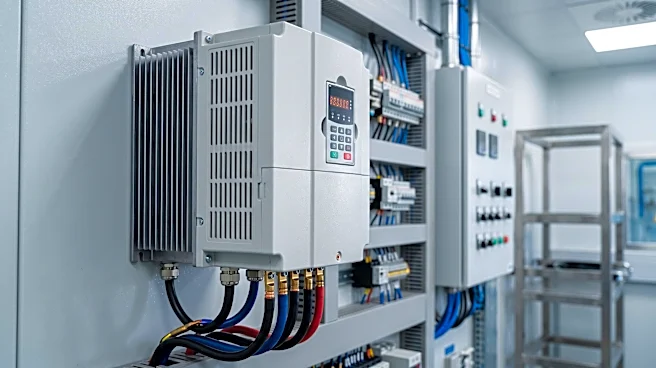
Distortion (THD) summarizes the combined harmonic content into a single percentage, useful for filtering and comparison, but it doesn't identify the source or specific harmonic orders. Non-linear loads, such as variable frequency drives (VFDs), uninterruptible power supplies (UPS), and LED drivers, are primary creators of harmonic currents. These currents, flowing through system impedance, generate harmonic voltage distortion. The article differentiates between THDv (voltage distortion), THDi (current distortion), and TDD (total demand distortion), emphasizing that these are not interchangeable and require specific contexts for accurate assessment. IEEE 519 standards apply distortion targets at the point of common coupling (PCC), not as universal limits for every device terminal.
Why It's Important?
Understanding power system harmonics and THD is crucial for maintaining the reliability, efficiency, and longevity of electrical infrastructure in the U.S. and globally. High harmonic content can lead to significant problems, including increased heating in conductors, transformers, and motors, potentially causing premature equipment failure and reduced operational lifespan. It can also result in neutral conductor overheating in three-phase systems due to triplen harmonics, motor torque pulsations, and capacitor overload due to resonance. These issues translate to higher energy losses, increased maintenance costs, and potential operational disruptions for industries, commercial buildings, and data centers. Proper measurement and mitigation of harmonics are essential for compliance with industry standards like IEEE 519, ensuring power quality, and preventing costly damages and downtime across various sectors reliant on stable electrical power.
What's Next?
The ongoing proliferation of non-linear loads in modern electrical systems, driven by advancements in power electronics and energy-efficient technologies, suggests that harmonic distortion will remain a critical concern. Future developments will likely focus on more sophisticated harmonic mitigation techniques, including advanced active harmonic filters, low-harmonic drives, and smart grid technologies capable of real-time harmonic analysis and compensation. There will be a continued emphasis on adherence to evolving standards like IEEE 519, with utilities and industrial consumers investing in power quality analyzers and specialized engineering studies to diagnose and address harmonic issues proactively. Research and development will also aim at designing equipment inherently less prone to generating harmonics and more resilient to their effects, ensuring a more stable and efficient electrical grid for future demands.
Beyond the Headlines
Beyond the technical aspects, the issue of power system harmonics has broader implications for energy sustainability and infrastructure resilience. As the U.S. transitions towards more renewable energy sources and electric vehicle adoption, the grid will experience increased integration of power electronic converters, which are significant sources of harmonics. This necessitates a holistic approach to grid modernization, where harmonic management is integrated into the design and operation of future power systems. There are also economic implications, as poor power quality due to harmonics can lead to financial penalties from utilities and increased operational expenses for businesses. From an environmental perspective, reducing harmonic losses contributes to overall energy efficiency, aligning with broader sustainability goals. The complexity of harmonic interactions also highlights the need for skilled electrical engineers and technicians capable of diagnosing and implementing effective solutions, underscoring the importance of specialized education and training in this field.