



What's Happening?
The White House Office of Trade and Manufacturing Policy has released a report titled 'The Great Transshipment Scam,' alleging that a 'shadow transshipment network' involving 40 different jurisdictions is being used to reroute Chinese-made goods to the
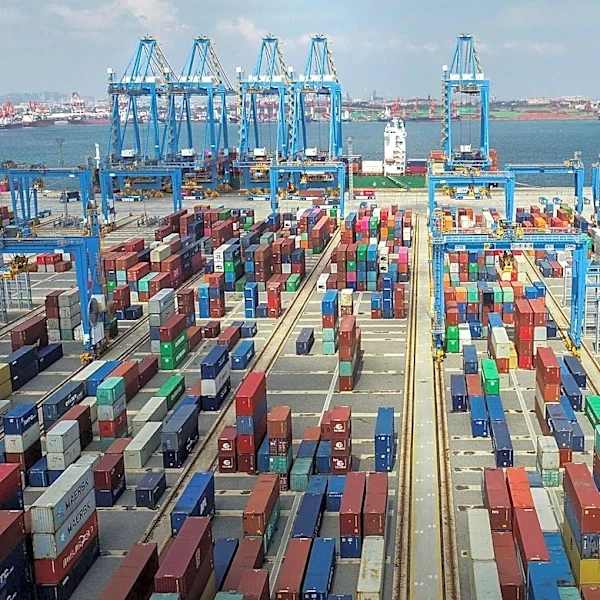
U.S., obscuring their true country of origin. This practice, according to the report, has cost the U.S. as much as $303 billion. Transshipment involves moving items from one country to another with an intermediate stop in a third country, potentially changing the good's country of origin. The White House report specifically targets instances where little to no value is added in the intermediate stop, suggesting practices like relabeling, repackaging, or false country-of-origin claims to circumvent tariffs. China, the European Union, and Singapore are among the entities pushing back against these accusations. A Chinese embassy spokesperson in Washington D.C. stated that China 'firmly opposes' the over-stretching of national security justifications to suppress Chinese enterprises and vowed to safeguard its interests. The European Commission spokesperson, Arianna Podesta, affirmed the EU's engagement with the U.S. on trade issues but emphasized that its regulatory autonomy is not 'up for negotiation.' Singapore's Ministry of Trade and Industry (MTI) reiterated its commitment to trade compliance and its reputation as a trusted international business hub, stating it 'does not condone businesses using their association with Singapore and using fraudulent and dishonest means to circumvent or violate the laws and regulations of other countries.'
Why It's Important?
This report highlights a significant point of contention in international trade relations, particularly between the U.S. and China, with broader implications for global supply chains and economic policy. The U.S. claims that illegal transshipment has led to the displacement of 450,000 jobs, a reduction in annual GDP by $113 billion to $150 billion, and federal revenue losses ranging from $19 billion to $26 billion. This suggests a substantial economic impact on the U.S. economy and its workforce. The report's naming of 40 economies, including key U.S. allies like Canada, Japan, South Korea, Taiwan, Israel, and Europe, as well as major trading partners like Mexico and India, could strain diplomatic and trade relationships. The accusation of a 'scam' implies a deliberate effort to bypass trade regulations, which could lead to increased scrutiny and potential retaliatory measures from the U.S. The pushback from China, the EU, and Singapore indicates a lack of consensus on the definition and extent of 'illegal transshipment,' potentially complicating future trade negotiations and enforcement efforts. The report also underscores the ongoing challenges in managing global trade in an era of complex supply chains and geopolitical tensions, where the origin of goods can significantly impact their tariff treatment and market access.
What's Next?
Despite the detailed accusations, the White House report did not specify immediate actions against China or the other 40 economies. However, it did outline plans for the U.S. to develop an 'AI-enabled detective border' designed to analyze global trade data and identify illicit transshipment activities. This indicates a future shift towards more technologically advanced methods of trade enforcement. Analysts, such as Song Seng Wun, an economic adviser at Singapore-based fintech company SDAX, suggest that merely being named in the report serves as a form of pressure, even without immediate regulatory or enforcement actions. This implies that the U.S. aims to increase compliance pressure on major transshipment hubs and manufacturing centers. The responses from China, the EU, and Singapore suggest that they will likely continue to defend their trade practices and potentially challenge the U.S.'s interpretation of transshipment. This could lead to ongoing diplomatic discussions, trade disputes, and potentially new trade policies or regulations from all parties involved. The development of AI-driven border security could also set a precedent for how international trade is monitored and regulated in the future, potentially leading to more sophisticated methods of detecting and preventing trade circumvention.
Beyond the Headlines
The 'Great Transshipment Scam' report delves into the complex and often opaque world of global supply chains, highlighting how companies adapt to tariffs and trade barriers. The practice of routing goods through third countries, even with some value-added processing, blurs the lines of origin and challenges traditional customs enforcement. This raises ethical questions about the spirit versus the letter of trade laws and the responsibility of nations to ensure fair trade practices. The report also touches upon the broader economic impact of such practices, not just in terms of lost revenue and jobs for the U.S., but also in potentially distorting global markets and creating unfair competitive advantages. The emphasis on an 'AI-enabled detective border' signals a growing reliance on technology to police international trade, which could lead to debates about data privacy, algorithmic bias, and the potential for overreach in trade surveillance. Furthermore, the report's implications extend to the ongoing geopolitical competition between the U.S. and China, where trade policies are increasingly intertwined with national security and economic dominance. The pushback from U.S. allies named in the report also underscores the delicate balance the U.S. must maintain between enforcing its trade policies and preserving its alliances.