







What's Happening?
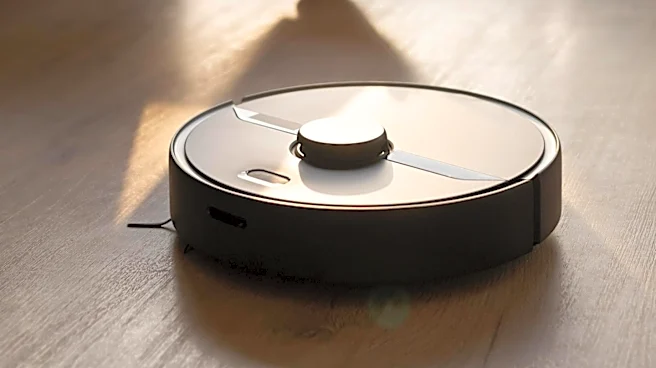
The Roborock Saros Z70 is highlighted as a highly innovative robot vacuum, featuring a unique mechanical arm designed to pick up light obstacles such as socks, tissues, or slippers. This advanced model offers comprehensive self-maintenance capabilities,
including self-washing, self-drying, self-emptying, self-refilling, and self-cleaning. It boasts a powerful 22,000Pa suction, FlexiArm Riser technology, and a dual-rotating-pad mopping system, aiming to provide thorough floor cleaning without manual intervention. The robot's OmniGrip arm deploys automatically when it detects an object it can carry, depositing it into a designated bin before resuming its cleaning path. While praised for its cutting-edge technology, the Saros Z70 is positioned for early adopters due to its experimental nature and higher price point, with potential for initial bugs as a new technology on the market.
Why It's Important?
The introduction of the Roborock Saros Z70 with its mechanical arm represents a significant leap in robot vacuum technology, addressing a common frustration for users: the need to pre-clear floors of small items. This innovation could redefine user expectations for robot vacuum autonomy and efficiency, potentially making these devices more practical for everyday use in busy households. For the U.S. market, this advancement could drive increased adoption among tech-savvy consumers and those seeking a truly hands-off cleaning experience. The high suction power and comprehensive self-maintenance features also set a new benchmark for performance and convenience in the smart home appliance sector. While the high cost and potential for bugs might limit initial widespread adoption, the technology showcased in the Saros Z70 could influence future designs across the industry, pushing competitors to develop similar or even more advanced obstacle-handling capabilities.
What's Next?
As a new and experimental technology, the Roborock Saros Z70 is expected to primarily attract early adopters who are willing to navigate potential initial bugs. Feedback from these users will be crucial for Roborock to refine the product and improve its reliability and user experience. Future iterations of the Saros Z70, or similar models from competitors, will likely focus on enhancing the mechanical arm's precision, expanding the range of objects it can handle, and integrating more sophisticated AI for object recognition and disposal. The success of this feature could lead to its integration into more budget-friendly models over time, making advanced obstacle avoidance a standard feature in robot vacuums. Additionally, the market will observe how this innovation impacts the competitive landscape, potentially spurring other manufacturers to invest more heavily in advanced robotic manipulation for domestic applications.
Beyond the Headlines
The mechanical arm on the Roborock Saros Z70 hints at a future where domestic robots are not just cleaners but active manipulators of their environment. This capability moves beyond simple navigation and cleaning, suggesting a pathway towards robots that can perform more complex tasks, such as tidying up, organizing, or even assisting with daily living activities. The ethical implications of robots interacting with and moving personal items within a home environment could become a more prominent discussion, particularly concerning privacy and the potential for unintended interactions. Furthermore, the development of such sophisticated robotics for consumer use could accelerate advancements in AI and machine learning, as these devices require highly accurate object recognition and decision-making capabilities to operate effectively and safely in dynamic home settings. This technology could also influence industrial and service robotics, demonstrating the feasibility of precise manipulation in unstructured environments.