





What's Happening?
Intel has released new technical specifications for its D270 GPU, codenamed Crescent Island, which is designed to integrate high-performance computing (HPC) and artificial intelligence (AI) inference capabilities. The D270 GPU is built on the Xe3P architecture,
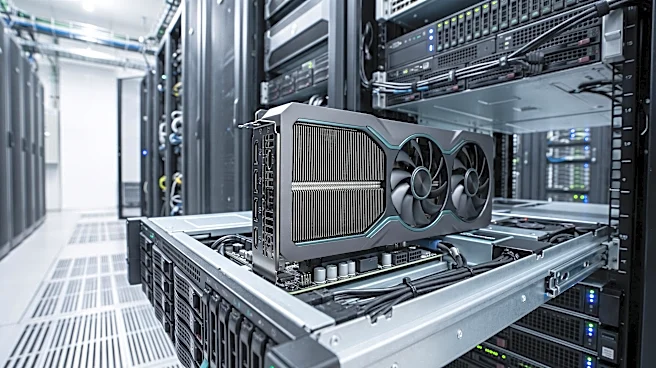
featuring 32 Xe Cores and 256 XMX units. A key highlight is its native full-rate FP64 support, which is crucial for scientific and technical HPC applications, alongside support for data types ranging from FP4 to FP64. This broad precision range allows the D270 to cater to both low-precision AI inference tasks and traditional double-precision computations required in fields like financial modeling and seismic imaging. The accelerator is equipped with 160 GB of LPDDR5X memory, providing 1.5 TB/s of memory bandwidth. It operates as an air-cooled PCIe 5.0 card with a power consumption of 350 watts, making it suitable for integration into existing data centers without requiring extensive liquid-cooling infrastructure. Intel aims to position the D270 as a versatile solution for data centers, scientific simulations, and AI inference workloads.
Why It's Important?
The introduction of Intel's D270 GPU signifies a strategic move to bridge the gap between traditional HPC and modern AI acceleration. By offering native full-rate FP64 support alongside AI inference capabilities on a single platform, Intel addresses a critical need for data centers and research institutions that require both high-precision numerical computations and efficient AI processing. Many contemporary AI accelerators prioritize low-precision formats, often limiting or sidelining traditional double precision. The D270's integrated approach could streamline workflows and reduce the need for separate hardware solutions for different computational tasks, potentially leading to cost efficiencies and simplified infrastructure management for U.S. businesses and research facilities. The choice of LPDDR5X memory, while offering lower bandwidth than HBM, could provide advantages in terms of cost, availability, and power consumption, making the D270 a more accessible option for a wider range of deployments. This development could enhance Intel's competitiveness in the rapidly evolving data center and AI hardware markets.
What's Next?
Intel has not yet disclosed the absolute FP64 performance figures for the D270 GPU, nor has it provided full details on how memory capacity can scale up to 480 GB when multiple cards are used together, particularly regarding data distribution across cards and interconnect mechanisms. Future announcements are expected to clarify these aspects, which will be crucial for evaluating the D270's real-world performance and scalability. The company also emphasizes an open software stack as part of its platform strategy, indicating that the effectiveness of the D270 will heavily depend on its compatibility with established HPC frameworks, compilers, libraries, and existing Xeon and GPU environments. Independent benchmarks will be necessary to assess the D270's efficiency per computation across FP64, FP32, and AI performance within its 350-watt power budget. The market will be watching for further details on performance metrics, software ecosystem support, and pricing to determine the D270's competitive standing against other high-end accelerators.
Beyond the Headlines
The D270's design philosophy, combining distinct compute paths with Xe Cores for traditional GPU operations and XMX units for matrix calculations and lower precision levels, reflects a broader industry trend towards heterogeneous computing. This approach acknowledges the diverse computational demands of modern workloads, where a 'one-size-fits-all' solution is increasingly insufficient. The emphasis on an open software stack is also a critical long-term factor, as hardware innovation must be accompanied by robust and accessible software tools to foster adoption and development. The D270's potential to be integrated into conventional servers due to its air-cooled PCIe 5.0 design could democratize access to advanced HPC and AI capabilities, allowing a wider array of organizations to leverage these technologies without significant overhauls of their existing infrastructure. This could accelerate innovation in various sectors, from scientific research to enterprise AI applications, by making powerful computing resources more readily deployable and manageable.