




What's Happening?
The Carlyle Group and the European Bank for Reconstruction and Development (EBRD) have reached an agreement to sell Black Sea Oil & Gas (BSOG) and BSOG Holding Activity to Mazarine Energy. This transaction will transfer ownership of Romania's largest
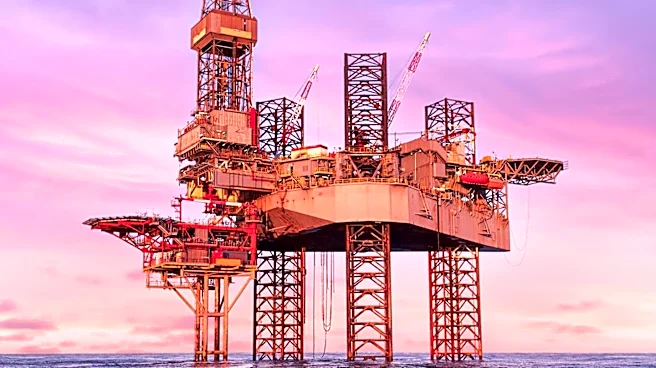
offshore natural gas producer to Mazarine Energy, an energy company already operating in the country. Carlyle initially invested in BSOG in 2015 when it was primarily an exploration-focused entity, with EBRD providing support since 2017. Under Carlyle's ownership, BSOG and its joint venture partners invested over $400 million in the Midia Gas Development (MGD) project. This project, which began producing natural gas in June 2022, became the first offshore hydrocarbon production hub developed in the Romanian Black Sea in over 30 years. The MGD project has since supplied approximately 12% of Romania’s domestic gas demand, significantly bolstering the country's energy security. The sale is pending customary regulatory approvals, after which BSOG will continue to operate the MGD project under Mazarine Energy's ownership.
Why It's Important?
This divestment highlights the successful development of a significant energy asset in a region with heightened concerns about energy security. For Carlyle, it demonstrates how private capital can support complex infrastructure projects from exploration to production, ultimately leading to a profitable exit. The MGD project's contribution of 12% to Romania's domestic gas demand underscores its strategic importance for the country's energy independence and stability. Mazarine Energy's acquisition expands its footprint in Romania, giving it control over an established offshore production platform with potential for future growth in both conventional and lower-carbon energy projects. This move could also influence future investment trends in the European energy sector, particularly in the context of transitioning towards more diversified and secure energy sources. The transaction reflects a broader trend of private equity firms developing and then divesting mature assets, allowing specialized operators to take over for the next phase of growth and optimization.
What's Next?
The transaction is currently awaiting customary regulatory approvals. Once these approvals are secured, Black Sea Oil & Gas will transition to Mazarine Energy's ownership, with operational continuity expected for the Midia Gas Development project. BSOG is also exploring additional opportunities beyond its current natural gas production, including potential carbon capture and storage development within the Midia block, offshore wind opportunities utilizing its existing energy corridor and land assets, and biomethane projects through its subsidiary, BSOG Energy. Mazarine Energy, with its established presence in Romania since 2017, is expected to leverage this acquisition to further expand its operations and contribute to Romania's long-term energy security. The successful integration of BSOG into Mazarine's portfolio will be a key focus, as will the continued exploration and development of these new energy initiatives.
Beyond the Headlines
The sale of Black Sea Oil & Gas to Mazarine Energy underscores the evolving landscape of energy investments, particularly the role of private equity in de-risking and developing critical infrastructure. Carlyle's journey with BSOG, from an exploration-stage company to a significant producer, exemplifies a model where patient capital can foster national energy security. The emphasis on potential carbon capture and storage, offshore wind, and biomethane projects within BSOG's future plans reflects a broader industry shift towards sustainable and diversified energy portfolios. This transaction could serve as a blueprint for how private investment can facilitate the energy transition in other European nations, balancing traditional fossil fuel production with emerging green technologies. The long-term implications include not only economic benefits for the involved companies but also enhanced energy resilience for Romania and potentially the wider European Union, as countries seek to reduce reliance on external energy sources and meet climate goals.