








What's Happening?
The GS1 General Specifications, the foundational global standard for barcode identification and data, provide detailed technical guidelines for manufacturers, printers, retailers, and technology providers. A key aspect addressed in these specifications
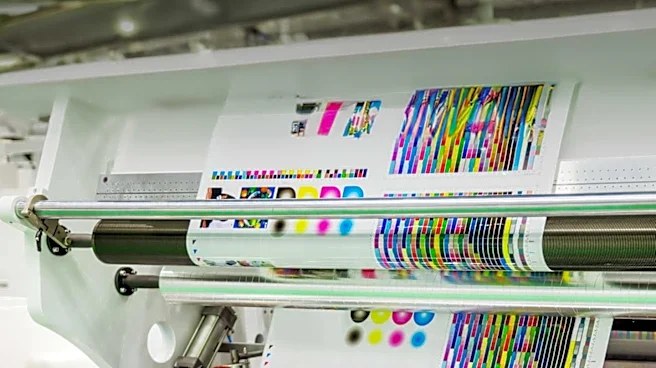
is the phenomenon of 'bar gain or loss' in conventional printing processes. This refers to the tendency for printed barcode bars to become wider or narrower than their original digital master. To counteract this, the specifications mandate evaluating bar gain or loss to determine the appropriate Bar Width Adjustment (BWA). Specifically, Section 5.12.4.2 of the current 2026 General Specifications states that if bar gain occurs, the master image must be adjusted to compensate, often through Bar Width Reduction (BWR). This ensures that the printed barcode remains accurate and scannable, maintaining the integrity of the global standard.
Why It's Important?
The meticulous detail in the GS1 General Specifications regarding barcode printing accuracy is critically important for the U.S. and global supply chains. Inaccurate barcodes can lead to significant operational inefficiencies, including scanning errors, delays in logistics, and incorrect inventory management. For businesses, this translates to increased costs, potential product recalls, and damage to brand reputation. The GS1 standards provide a common language for trading partners, enabling seamless data exchange and product identification across diverse industries. By ensuring that barcodes are 'print-ready' and conform to precise specifications, GS1 helps maintain the reliability of automated systems that underpin retail, manufacturing, and distribution. This benefits consumers through accurate product information and efficient transactions, while businesses gain from streamlined operations and reduced errors, ultimately supporting a more robust and interconnected global economy.
What's Next?
As technology evolves, the GS1 General Specifications will continue to adapt to new printing methods and digital applications. The emphasis on 'Print-Ready Digital Barcodes' suggests a future where digital masters are increasingly sophisticated, incorporating precise adjustments like BWR to ensure optimal print quality. This will likely lead to further integration of barcode generation and printing processes, with software solutions becoming more intelligent in anticipating and correcting potential printing inaccuracies. Manufacturers and printers will need to stay updated with the latest GS1 specifications and invest in technologies that support these precise adjustments. The ongoing development of GS1 Digital Link and other advanced barcode technologies will also necessitate continuous refinement of these foundational printing guidelines to ensure interoperability and accuracy in an increasingly digital supply chain environment.
Beyond the Headlines
The seemingly technical details of barcode printing accuracy have profound implications beyond mere logistics. They represent a critical layer of trust and standardization in global commerce. The ability to reliably identify and track products through a standardized system like GS1 underpins consumer safety, product authenticity, and efficient trade. Without such rigorous standards, the complexity of modern supply chains would be unmanageable, leading to widespread confusion and economic disruption. The continuous effort to refine these specifications highlights the ongoing challenge of bridging the gap between digital information and physical production, ensuring that the digital representation of a product accurately translates into its physical manifestation. This commitment to precision is a testament to the foundational role that seemingly small details play in the functioning of a vast and interconnected global economy.