








What's Happening?
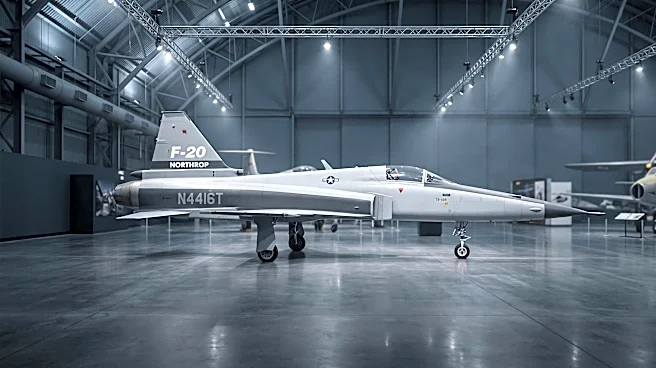
The Northrop F-20 Tigershark, a single-seat, single-engine light fighter developed as a successor to the F-5E Tiger II, is widely considered a marketing failure. Northrop invested approximately $1.2 billion over more than ten years into the program, but
ultimately sold no aircraft. Only three F-20s were built, with two crashing during sales demonstrations. The first crash occurred on October 10, 1984, at Suwon Air Base in South Korea, killing Northrop's chief test pilot, Darrell Cornell. The accident was attributed to the pilot losing consciousness under high g-forces. The second crash happened on May 14, 1985, at Goose Bay, Labrador, killing Northrop pilot David Barnes during practice for the Paris Air Show, also attributed to g-induced loss of consciousness. Investigations by Northrop and the Air Force found no aircraft system failures in either incident. The third F-20 is now owned by the California Science Center in Los Angeles.
Why It's Important?
The F-20 Tigershark's failure highlights significant shifts in U.S. arms export policy and market dynamics during the 1980s. Initially conceived to meet a demand for an export-only fighter after the Carter administration restricted sales of advanced jets like the F-15 and F-16 to certain allies, the F-20 lost its market when the Reagan administration relaxed these restrictions in 1981. This policy change allowed countries like Pakistan, Venezuela, and South Korea to purchase the F-16, which was already in service with the U.S. Air Force and Navy. The F-16's operational status with the U.S. military provided a level of credibility and assurance that the F-20, despite its technical merits, could not match. The F-20's crashes, though not attributed to aircraft malfunction, further solidified a perception of risk among potential buyers, making it difficult for Northrop to compete against the F-16, which was perceived as a proven platform.
What's Next?
While the F-20 program was terminated on November 17, 1986, its legacy continues to be studied as a case of marketing failure in the defense industry. The surviving F-20, 82-0064, is preserved at the California Science Center, serving as a historical artifact of an ambitious but ultimately unsuccessful project. Elements of the F-20's technology, such as the AN/APG-67 radar, found application in other aircraft like Taiwan's AIDC F-CK-1 Ching-kuo fighter and South Korea's T-50 Golden Eagle. The program's outcome underscores the critical importance of government policy, market conditions, and perceived operational endorsement in the success of defense projects, even for technically capable aircraft. Future defense manufacturers continue to navigate similar challenges in securing contracts and establishing market presence for new platforms.
Beyond the Headlines
The F-20 Tigershark's story extends beyond a simple commercial failure, touching upon the complex interplay between technological innovation, geopolitical strategy, and economic realities in the defense sector. Northrop's decision to privately fund the entire development program, spending $1.2 billion, was a significant gamble that ultimately did not pay off. This approach contrasted with the typical government-funded development of military aircraft, illustrating the high risks associated with independent ventures in a heavily regulated and politically influenced market. The F-20's technical capabilities, including its faster scramble time and claimed higher reliability compared to the F-16, were overshadowed by the F-16's established operational record and the U.S. government's endorsement. This case highlights how even superior technical specifications may not guarantee market success if broader strategic and political factors are not aligned, offering valuable lessons for future defense procurement and export strategies.