

What's Happening?
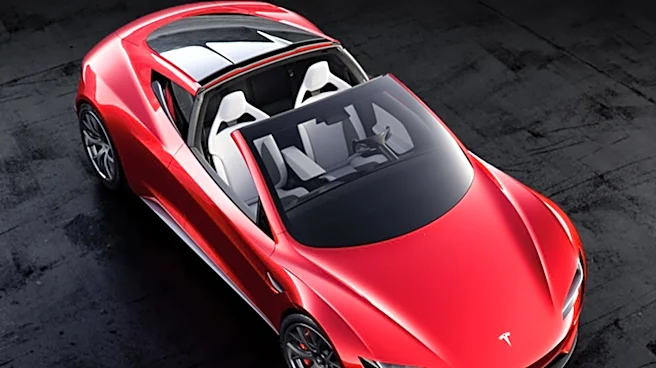
Directors from Tesla and SpaceX are currently engaged in negotiations for a potential all-stock merger, reportedly valued at approximately $3.5 trillion. The Financial Times initially reported on November 24 that both Elon Musk-led companies have appointed
special committees to discuss the terms of this combination. Tesla's committee includes Chair Robyn Denholm, Kathleen Wilson-Thompson, and Jack Hartung, advised by Evercore. SpaceX's committee comprises Roelof Botha and Randy Glein, with Morgan Stanley and Goldman Sachs acting as advisors. While discussions are ongoing, sources close to the talks indicate that an agreement is not yet imminent, though a deal by year-end remains a possibility. Elon Musk, who leads both companies, is not directly involved in these negotiations. Tesla's shares closed at $400.00 on November 27, marking a 5.22% increase, following reports of the merger talks.
Why It's Important?
A merger between Tesla and SpaceX would create a colossal entity with significant implications across multiple U.S. industries, including automotive, aerospace, and satellite communications. The combined valuation of $3.5 trillion would establish one of the largest corporations globally, potentially reshaping market dynamics and competitive landscapes. For Tesla, integrating SpaceX's advanced engineering and manufacturing capabilities could accelerate its innovation in areas like battery technology and autonomous systems. Conversely, SpaceX could benefit from Tesla's mass-market production expertise and global distribution networks. This consolidation could lead to enhanced vertical integration, cost efficiencies, and a broader portfolio of products and services. However, the deal faces a high approval bar, particularly for Tesla, where a majority of all outstanding shares, not just votes cast, would need to approve the merger at a separate shareholder meeting. This requirement means unvoted shares would count against the proposal, making shareholder consensus crucial.
What's Next?
The special committees for Tesla and SpaceX, formed on October 20, are continuing to build financial models and negotiate an exchange ratio for the all-stock combination. A definitive agreement, if reached, would necessitate disclosure in a regulatory filing. The proposed merger requires approval from SpaceX's special committee, its board, and its controlling shareholder, as well as a majority of all outstanding Tesla shares at a separate shareholder meeting. Tesla's annual meeting is scheduled for December 3, where Chair Robyn Denholm, among others, is up for re-election, despite proxy advisors ISS and Glass Lewis recommending against her re-election. Beyond internal approvals, a combination could also face regulatory review in the United States, China, Europe, and Britain, given Tesla's global operations and SpaceX's diverse business interests.
Beyond the Headlines
The potential merger between Tesla and SpaceX raises profound questions about corporate governance, market concentration, and the future of innovation. Elon Musk's unique position as leader of both companies, while not directly involved in negotiations, underscores the complex interplay of his vision and the corporate structures designed to manage such large-scale enterprises. The high bar for Tesla shareholder approval highlights the increasing scrutiny on corporate deals and the power of institutional and individual investors. Furthermore, the sheer scale of a $3.5 trillion combined entity could trigger antitrust concerns and debates about market dominance, potentially influencing future regulatory frameworks for technology and aerospace sectors. The outcome of these negotiations could set a precedent for how multi-billion-dollar, multi-industry mergers are conceived, negotiated, and approved in the U.S. and globally.