




What's Happening?
iPronics, a developer of silicon photonics-based optical circuit switching for AI infrastructure, has announced it secured $125 million in Series B funding. The round was co-led by Maverick Silicon and Light Street Capital, with NVIDIA also participating.
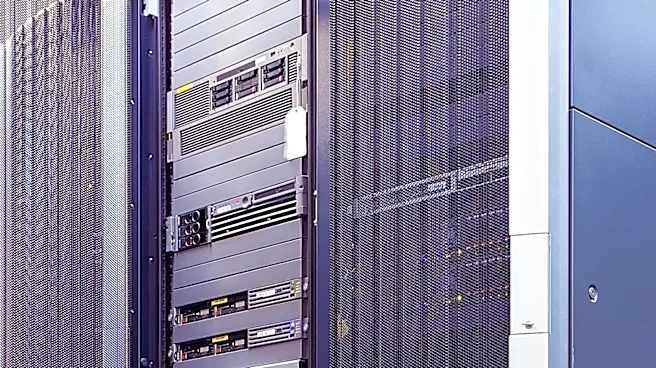
This latest funding brings iPronics' total funding to $177 million. The company plans to use these funds to significantly scale its operations, accelerate commercial deployment, and meet the increasing market demand for its iPronics Optical Networking Engine (ONE). The iPronics ONE is a rack-mounted optical switch designed for AI, featuring integrated control, telemetry, and APIs, which provides a programmable optical layer enabling AI clusters to reconfigure connectivity in real-time for training and inference workloads. The company has also opened an office in Santa Clara, California, to strengthen its U.S. presence.
Why It's Important?
This substantial investment in iPronics highlights the critical need for advanced optical networking solutions to support the explosive growth of AI workloads in data centers. As AI clusters expand, traditional network infrastructure faces power and bandwidth limitations, making optical circuit switching essential for maintaining performance and managing costs. For the U.S. technology sector, this funding signifies a major step forward in developing the infrastructure necessary for next-generation AI. It indicates strong investor confidence in silicon photonics as a key technology for scaling AI compute demand. The involvement of major players like NVIDIA further validates the importance of iPronics' technology, suggesting a potential shift in how AI data centers are designed and operated, with significant implications for hyperscalers and cloud service providers in the U.S.
What's Next?
iPronics will focus on accelerating the commercial deployment of its Optical Networking Engine (ONE) and expanding its market reach, particularly within the U.S. with its new Santa Clara office. The company is actively hiring to bolster its product strategy, customer deployments, and AI infrastructure partnerships. This increased capacity and commercialization effort will likely lead to broader adoption of programmable optical networking in AI data centers, potentially setting new industry standards for connectivity and efficiency. Competitors in the optical networking space will need to innovate rapidly to keep pace with iPronics' advancements. The success of iPronics could also spur further investment in silicon photonics and related technologies, driving more innovation in the AI infrastructure ecosystem.
Beyond the Headlines
The significant investment in iPronics reflects a deeper technological imperative driven by the demands of artificial intelligence. The shift from copper to optics in data center networks is not merely an incremental improvement but a fundamental change in how data is moved and processed at scale. This has profound implications for energy consumption in data centers, as optical solutions are generally more power-efficient, contributing to sustainability goals. Ethically, the ability to reconfigure AI clusters in real-time could lead to more efficient resource utilization, reducing the environmental footprint of AI. Legally, the development of proprietary optical switching technologies could lead to new intellectual property battles in the high-tech sector. Culturally, the continuous push for faster, more efficient AI infrastructure underscores humanity's relentless pursuit of computational power, shaping the future of technology and its societal impact.