



What's Happening?
Cinematographer Kim Ji-yong recently shared insights into his work on various projects, including the film 'Possible Love' and the series 'Black Rabbit'. Kim, known for his contributions to 'Decision to Leave' and 'Squid Game Season 2', detailed his collaboration
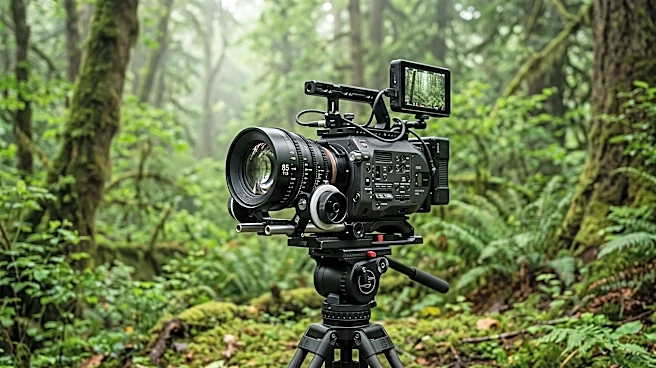
with director Lee Chang-dong on 'Possible Love'. He rewatched all of Lee's films before starting the project, citing 'Poetry' as his favorite. Kim described the script for 'Possible Love' as initially challenging to understand, which motivated him to take on the project to grasp its full scope during filming. He utilized an ARRI ALEXA 35 camera with ZEISS Super Speed and Angénieux EZ-Series lenses, favoring a handheld approach to follow characters naturally and avoid intentional mise-en-scène. A notable sequence involved creating artificial wind with nearly 100 crew members for a scene in the woods, as natural wind was absent. Kim also discussed the use of subtle flashbacks in 'Possible Love', a departure from Lee's usual style, and the absence of detailed storyboards except for a specific rooftop protest scene.
Why It's Important?
Kim Ji-yong's reflections offer a valuable glimpse into the technical and artistic decisions behind contemporary filmmaking, particularly within the U.S. and international entertainment landscape. His preference for handheld cinematography and natural character movement highlights a trend towards more immersive and less overtly stylized visual storytelling. The anecdote about creating artificial wind underscores the innovative problem-solving required in film production, showcasing how creative teams overcome environmental challenges to achieve a director's vision. Furthermore, his discussion of working with acclaimed directors like Lee Chang-dong and his involvement in globally recognized projects such as 'Squid Game Season 2' demonstrates the interconnectedness of the global film industry. These insights can influence aspiring cinematographers and filmmakers, providing practical examples of how artistic vision is translated into on-screen reality and contributing to the evolving craft of visual narrative.
What's Next?
While the article primarily focuses on past and current projects, Kim Ji-yong's continued involvement in high-profile productions like 'Squid Game Season 2' suggests his ongoing influence in the entertainment industry. His approach to cinematography, emphasizing naturalism and adaptability, is likely to continue shaping the visual aesthetics of future films and series. The techniques and philosophies he employs, such as minimal storyboarding and on-set improvisation, could inspire other filmmakers to explore similar methods. As the global demand for diverse and high-quality content grows, cinematographers like Kim Ji-yong will remain crucial in defining the visual language of storytelling, potentially leading to more collaborative international projects and a broader exchange of cinematic techniques. His work on 'Black Rabbit' further indicates his engagement with varied narrative forms, from feature films to limited series, reflecting the dynamic nature of content creation.
Beyond the Headlines
Kim Ji-yong's narrative extends beyond mere technical details, touching upon the deeper collaborative and interpretive aspects of filmmaking. His willingness to undertake a project like 'Possible Love' despite initial script complexities speaks to a profound artistic trust and a desire for discovery within the creative process. This approach challenges the conventional notion of a cinematographer as solely a technical executor, positioning them instead as a co-creator who actively engages with the narrative's evolving meaning. The distinction between 'movie gods' and 'crew gods' subtly highlights the collective effort and often unsung contributions of the entire production team, emphasizing that cinematic magic is a product of extensive collaboration rather than individual genius. This perspective fosters a more holistic understanding of film production, where every role, from director to crew member, is integral to the final artistic outcome, influencing how audiences perceive the authenticity and depth of a film's visual storytelling.