
What's Happening?
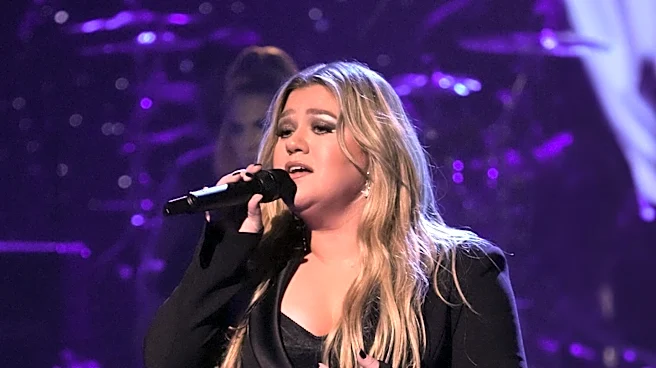
Kelly Clarkson, the 'Stronger' singer and talk show host, has sparked controversy and backlash after publicly expressing her 'obsession' with artificial intelligence (AI). During a September 30 episode of 'Las Culturistas,' hosted by Bowen Yang and Matt
Rogers, Clarkson stated, 'Controversial, I don't care: I love AI. There are very amazing things with AI that I am obsessed with.' She clarified that she uses AI 'artistically' herself and believes it can be a 'designer's dream,' citing an example of using it to communicate landscaping ideas. However, she drew a line when AI is pitted against human capabilities, advocating for separate music charts for AI-generated music versus human-created music. Her comments have led to criticism from listeners, with some expressing dismay on platforms like Reddit and X, particularly from individuals in creative fields like graphic design who view AI as a threat to their livelihoods.
Why It's Important?
This situation highlights the growing tension and debate surrounding the integration of artificial intelligence into creative industries, particularly music and design. Kelly Clarkson's comments, while expressing a personal enthusiasm for AI's artistic potential, have inadvertently touched upon a sensitive nerve for many who fear job displacement and the devaluation of human creativity. The call for separate music charts for AI-generated content reflects a broader concern within the entertainment industry about fair competition and intellectual property in an era where AI can rapidly produce content. This discussion is crucial for policymakers, industry leaders, and artists as they navigate the ethical, economic, and artistic implications of AI. The backlash against a prominent figure like Clarkson underscores the public's strong feelings and anxieties about AI's impact on human endeavors and livelihoods.
What's Next?
The debate surrounding AI's role in creative fields is expected to intensify as the technology continues to advance. Stakeholders in the music and design industries, including artists, unions, and technology companies, will likely continue to advocate for policies and guidelines that address concerns about intellectual property, fair compensation, and the distinction between human and AI-generated content. Discussions around separate charts or labeling for AI-created works could gain traction as a way to manage competition and transparency. Public figures like Kelly Clarkson may become more cautious in their endorsements of AI, or they might choose to further engage in the conversation to clarify their positions and address the concerns of their audience. The ongoing evolution of AI will necessitate continuous dialogue and adaptation from all sectors affected by its capabilities.
Beyond the Headlines
The controversy surrounding Kelly Clarkson's remarks delves into deeper societal questions about the definition of creativity, the value of human artistry, and the future of work in an increasingly automated world. It exposes a fundamental philosophical divide: whether AI is merely a tool to augment human capabilities or a potential replacement that could diminish the unique contributions of human talent. The emotional responses from graphic designers and other creatives underscore the existential threat many feel as AI encroaches upon domains traditionally considered uniquely human. This debate extends beyond economic concerns, touching upon cultural values and the very essence of what it means to create. The long-term implications could include a re-evaluation of intellectual property laws, the emergence of new artistic movements that either embrace or reject AI, and a societal shift in how we perceive and consume creative content.