




What's Happening?
Bitcoin's 90-day correlation with gold has reached its highest recorded level, peaking at 0.56 on October 22, surpassing the previous record of 0.50 from November 6, 2020. This data, reported by Galaxy Research, indicates a significant shift in how Bitcoin is trading
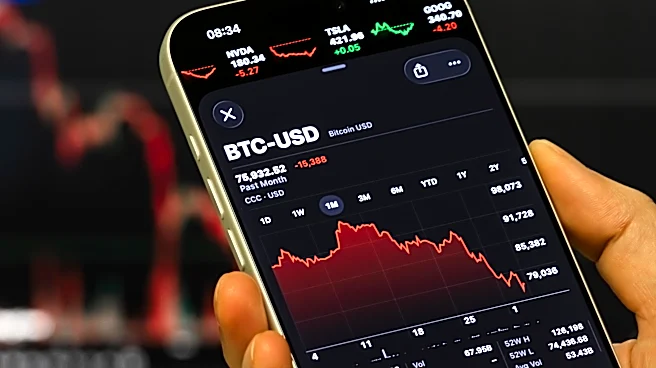
relative to gold. Alex Thorn, head of firmwide research at Galaxy Digital, highlighted this development, questioning the 'digital gold' narrative for Bitcoin. In the first half of 2026, the 90-day correlation remained near 0.1, but it began to climb in July, exceeding 0.50 by early October. The average correlation between 2020 and 2025 was 0.11. Despite this increased correlation, Galaxy CEO Mike Novogratz noted on January 20 that gold's price suggests a rapid loss of reserve currency status, while Bitcoin continues to face selling pressure. Galaxy Research also recently withdrew its October 26 call that the Bitcoin bear market had ended, with Thorn stating that the bear market is "definitely not over." Bitcoin closed the week ending November 22 at $61,104 after seven consecutive weekly losses. The report identified $58,525, Bitcoin's closing low from June 30, as a critical level, with a daily close below it potentially signaling a move to a significantly lower low.
Why It's Important?
The unprecedented correlation between Bitcoin and gold carries significant implications for investors and the broader financial market. Historically, Bitcoin has often been touted as 'digital gold,' a safe-haven asset that could act as a hedge against inflation and economic instability, similar to traditional gold. However, its recent behavior, particularly its increased correlation with gold during a period of market uncertainty, challenges this narrative. If Bitcoin is increasingly trading in tandem with gold, its diversification benefits for portfolios might be diminished, especially for those seeking assets that move independently of traditional markets. This shift could influence institutional adoption, as investors re-evaluate Bitcoin's role as a distinct asset class. Furthermore, the ongoing bear market in Bitcoin, as acknowledged by Galaxy Research, suggests that despite the correlation with gold, Bitcoin is still struggling to find a bottom. This prolonged downturn could deter new entrants and impact the overall sentiment around digital assets, potentially leading to further price declines if key support levels are breached. The performance of U.S. spot Bitcoin ETPs, which have seen a decrease in holdings, further underscores the cautious sentiment among investors.
What's Next?
The immediate focus for Bitcoin investors will be the critical price level of $58,525. A daily close below this point, which was Bitcoin's closing low from June 30, could trigger a more substantial downward trend, potentially leading to new lows around $48,500 and even $28,200, according to Galaxy's analysis. This would extend the current bear market, which has already lasted 412 days, beyond the typical duration of previous bear markets (163 to 406 days). The market will also be closely watching for any signs of a reversal in the increased correlation between Bitcoin and gold. If this correlation persists or strengthens, it could solidify Bitcoin's position as a more traditional asset, rather than a distinct, uncorrelated digital asset. The sentiment from key figures like Mike Novogratz, who expressed skepticism about Bitcoin reaching $90,000 by the end of 2026, suggests a cautious outlook for the near future. The performance of U.S. spot Bitcoin ETPs will also be a key indicator, as continued outflows could signal sustained selling pressure.
Beyond the Headlines
The evolving relationship between Bitcoin and gold raises fundamental questions about the nature and future role of digital assets in the global financial system. The 'digital gold' narrative, which has been a cornerstone of Bitcoin's appeal, is being re-examined as its correlation with traditional gold strengthens. This could lead to a re-evaluation of Bitcoin's fundamental properties and its perceived value proposition as a hedge against economic instability. If Bitcoin is increasingly seen as simply another asset that moves with broader market trends, rather than a unique, uncorrelated store of value, it could impact its long-term adoption and regulatory treatment. The ongoing bear market, coupled with this shifting correlation, highlights the inherent volatility and speculative nature of cryptocurrencies. This period of uncertainty may prompt regulators to consider new frameworks for digital assets, potentially influencing how they are classified and traded. Furthermore, the discussion around the U.S. dollar's reserve currency status, as mentioned by Novogratz, adds another layer of complexity, suggesting that broader macroeconomic shifts could be influencing both gold and Bitcoin's performance.