
What's Happening?
Fluro, a specialist in spherical plain bearings and rod ends, is revolutionizing its warehousing and production processes by constructing a new production and logistics hall. This initiative involves a fundamental
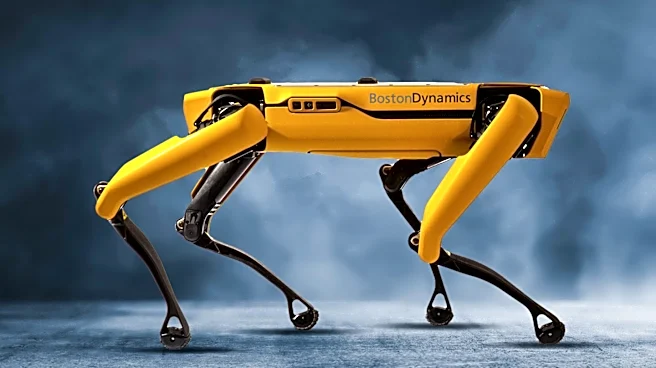
redesign of existing material flows, moving away from rigid conveyor technology. The company is integrating five autonomous mobile robots to transport pallets and containers between the warehouse, order picking, and production. The new facility will feature a two-aisle pallet warehouse and a shuttle-based small parts warehouse. Overseeing these operations is the UniWare warehouse management system, which connects the entire intralogistics system to Fluro's ERP system. This strategic shift aims to enhance flexibility and adaptability in material handling. The planned operational launch for this advanced system is set for December 2027. This move reflects a broader trend in the industry towards more intelligent, adaptable, and software-driven automation solutions, rather than solely relying on permanently installed technology.
Why It's Important?
This development is significant for the manufacturing and logistics sectors, particularly for medium-sized industrial companies. Fluro's adoption of autonomous mobile robots and an integrated warehouse management system demonstrates a strategic shift towards flexible intralogistics, which can offer substantial economic value. Unlike traditional fixed conveyor systems, mobile robots provide adaptability, allowing companies to respond to changing production programs, material flows, and market demands without incurring significant conversion costs. This flexibility is crucial in an uncertain industrial environment where product variants, manufacturing technologies, and market demands can shift rapidly. The investment in reconfigurable systems, rather than rigid infrastructure, allows for better inventory management, reduced capital commitment, and improved delivery capabilities. This approach can lead to more transparent inventory management and nuanced control, ultimately impacting a company's ability to maintain competitive advantage and meet customer expectations in a dynamic market.
What's Next?
The new production and logistics hall, featuring the autonomous mobile robots and UniWare WMS, is scheduled to become operational in December 2027. Following the launch, Fluro will likely focus on optimizing the integration of its new intralogistics system with its existing ERP system to ensure seamless data flow and operational efficiency. The company will need to rigorously manage data quality, define clear process rules, and establish accountability to maximize the benefits of automation. Attention will also be given to exception handling, ensuring the system can effectively manage disruptions such as damaged containers or rush orders. The success of this implementation could serve as a case study for other medium-sized manufacturers considering similar transitions, potentially influencing broader adoption of flexible automation solutions in the U.S. manufacturing landscape. Continuous evaluation and adaptation of the system will be crucial to respond to evolving market conditions and technological advancements.
Beyond the Headlines
Fluro's move highlights a deeper trend in industrial automation: the shift from optimizing for a single, expected state to optimizing for adaptability and the ability to manage multiple possible states. This reflects a growing recognition that in today's rapidly changing global economy, flexibility can be more valuable than marginal gains in maximum throughput from rigid systems. The project also underscores the increasing importance of software and data quality in automation. The UniWare warehouse management system's role in translating commercial and production requirements into operational tasks demonstrates that the 'digital nervous system' is as critical as the physical hardware. This emphasis on software-driven solutions and data integrity has ethical implications regarding data privacy and security, as well as the need for a skilled workforce capable of managing these complex integrated systems. The long-term impact could be a redefinition of manufacturing efficiency, where resilience and responsiveness become paramount, potentially leading to new industry standards and operational paradigms.