



What's Happening?
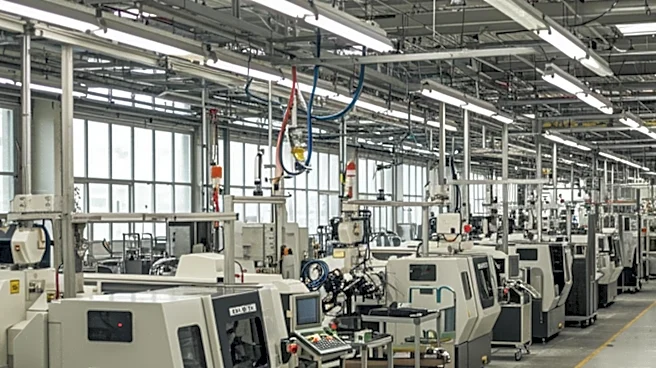
Isembard, a company specializing in manufacturing precision parts for defense primes, has expanded its operational footprint to 17 factories. This network spans six U.S. states, the UK, France, and Germany. According to CEO Alexander FitzGerald, speaking
at Slush 2026 Startup Stage, the majority of these factories are franchised, with only four being company-owned. The franchised factories can be established in approximately 90 days. Isembard's operations are coordinated through its proprietary software, Mason OS, which manages orders and production across the entire network. The company currently employs around 100 people and manufactures parts for clients such as Anduril, Helsing, and Tekever. FitzGerald also announced a new deal with Babcock, indicating further growth and strategic partnerships.
Why It's Important?
This expansion by Isembard signifies a notable development in the defense manufacturing sector, particularly concerning the agility and scalability of supply chains. The rapid establishment of franchised factories, achievable within 90 days, demonstrates a model that could significantly enhance responsiveness to defense procurement needs. This approach allows for decentralized production while maintaining centralized control through Mason OS, potentially mitigating risks associated with single points of failure and improving logistical efficiency. For the U.S. defense industry, this means a more robust and distributed manufacturing base, which is crucial for national security and supporting allied operations. The ability to quickly scale production and integrate new facilities could provide a competitive advantage in meeting the evolving demands of modern defense. The new deal with Babcock further solidifies Isembard's position as a key supplier to major defense contractors.
What's Next?
Isembard plans to continue its aggressive expansion, with intentions to enter 15 more countries within the next 12 to 18 months. This international growth will further broaden its manufacturing capabilities and supply chain reach, potentially establishing Isembard as a global leader in defense component production. The company's franchised model suggests that this expansion could be executed with relative speed and efficiency, leveraging local partnerships. The continued development and integration of Mason OS will be critical in maintaining operational coherence across an increasingly diverse and geographically dispersed network of factories. Future developments will likely include further strategic partnerships with defense primes and continued innovation in manufacturing processes to meet the complex demands of advanced defense systems.
Beyond the Headlines
The operational model employed by Isembard, heavily relying on franchised factories and proprietary software for coordination, presents a fascinating case study in modern manufacturing and supply chain management. This approach challenges traditional models of large-scale industrial production by emphasizing speed, flexibility, and distributed capabilities. The ethical implications of such a model in the defense sector include questions of oversight and quality control across a diverse network of independently operated facilities, even with centralized software. Legally, the franchising agreements in multiple international jurisdictions will require careful navigation. Culturally, this model could foster a more collaborative and decentralized defense industrial base, potentially empowering smaller entities to contribute to national security efforts. The long-term shift could see a more resilient and adaptable defense manufacturing ecosystem, less vulnerable to geopolitical disruptions and more capable of rapid innovation.