
What's Happening?
The U.S. labor market is undergoing significant transformation due to the expansion of AI, according to Dr. Svenja Gudell, Indeed chief economist. Indeed Hiring Lab's research indicates that AI is changing
the mix of jobs employers need, rather than just the total number. U.S. 'AI-touched' job titles, defined as standardized titles with at least five postings mentioning AI, increased from 264 in early 2022 to 822 in early 2026, representing 8.3% of all U.S. job titles. Notably, almost two-thirds (63%) of these AI-touched titles are outside traditional tech occupations. Searches for AI-related roles grew elevenfold between November 2022 and early 2026, and over 6% of all U.S. job postings mentioned AI or related keywords as of July. Despite this growth, the U.S. labor force is projected to decline by approximately 5.9 million workers by 2032, largely due to aging and retirement, and by 1.2 million workers by 2040 at current immigration levels.
Why It's Important?
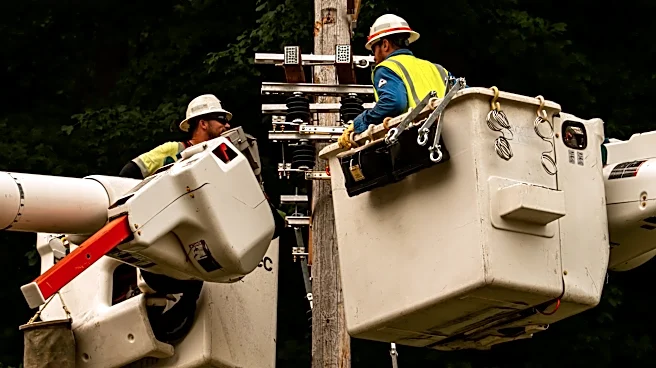
This shift in the labor market highlights a growing mismatch between the skills workers possess and the roles the economy increasingly demands, particularly as AI's impact is unevenly distributed. While AI is creating new job categories and increasing demand for specific skills, its greatest potential impacts are concentrated in sectors like information, financial activities, and professional and business services. Conversely, significant worker shortages are projected in construction, healthcare, and government, where AI is expected to offer less relief. This creates a challenge where new labor market entrants are still pursuing well-supplied white-collar fields, rather than moving into areas with critical shortages. The data suggests an augmentation scenario where AI improves productivity and creates new tasks, rather than primarily replacing human work. However, even with AI-driven job creation, demographic shifts are projected to lead to substantial employment losses, underscoring the need for better pathways to connect workers with emerging roles and address skill gaps.
What's Next?
Addressing the looming worker shortages and the evolving demands of the AI economy will require significant adjustments in workforce development and education. The average job posting now requires two more skills than before the pandemic, and a growing number of non-tech postings demand at least one technical skill. This indicates a need for continuous upskilling and reskilling initiatives to equip workers with the necessary competencies for AI-touched roles. Better matching mechanisms are crucial to help employers recognize existing worker skills, differentiate between day-one qualifications and on-the-job learning, and identify adjacent opportunities. AI itself may play a role in helping individuals acquire occupation-specific skills. However, even with these efforts, AI-driven job creation and productivity are only expected to offset a fraction of the employment losses caused by demographic shifts, meaning total job losses could still reach approximately 2 million by 2040. Policymakers and industries will need to collaborate on strategies to mitigate these shortages and ensure a resilient workforce.
Beyond the Headlines
The uneven impact of AI across different sectors raises questions about economic equity and social mobility. If AI primarily benefits already well-supplied white-collar fields, it could exacerbate existing inequalities, leaving workers in sectors facing shortages with fewer opportunities for AI-driven augmentation. The increasing demand for experienced professionals who can work with AI, as seen in the software developer rebound concentrated in senior roles, suggests a potential widening of the skills gap between entry-level and experienced workers. Furthermore, the significant investment in data center infrastructure, driven by AI, highlights the foundational physical requirements of the digital economy, creating demand for skilled trades alongside traditional tech expertise. This interplay between high-tech and traditional labor markets will be a critical area to watch, as it shapes the future of work and the distribution of economic benefits from AI adoption.