




What's Happening?
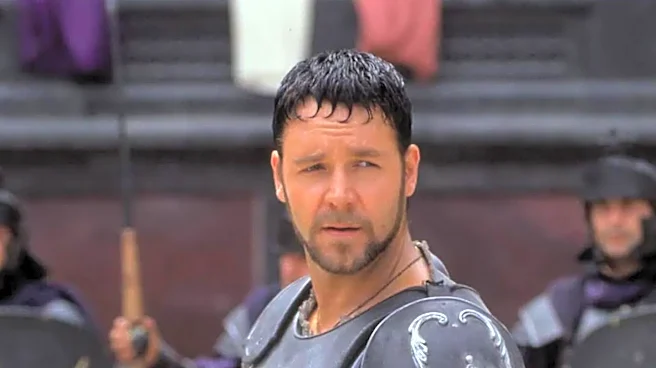
Russell Crowe's portrayal of Dr. Henry Jekyll in the 2017 film 'The Mummy' has drawn significant criticism, with reviewers suggesting his performance was undermined by poor scripting and characterization. The film, intended to launch Universal's 'Dark
Universe' cinematic franchise, featured Crowe as the head of a mysterious organization called Prodigium. Critics argue that Crowe's 'cartoonishly bad' performance and the character's unnecessary inclusion detracted from the movie's core narrative. The character of Dr. Jekyll, who transforms into Mr. Hyde, was noted for switching between an upper-class English accent and a 'cartoonish working-class Cockney accent,' which was perceived as a misstep. This focus on establishing a broader cinematic universe, rather than developing a cohesive 'Mummy' story, is cited as a major flaw, with Crowe's role consuming significant screen time without contributing meaningfully to the plot.
Why It's Important?
The critical reception of Russell Crowe's role in 'The Mummy' highlights the challenges and risks associated with launching interconnected cinematic universes. Studios often prioritize setting up future installments over crafting a strong standalone film, which can lead to disjointed narratives and underdeveloped characters. In this case, the attempt to introduce Prodigium and Dr. Jekyll as a foundational element for the 'Dark Universe' reportedly diluted the primary story, impacting audience engagement and critical success. This approach can result in significant financial losses for studios and damage the potential for future franchise entries. For actors, taking on roles in such ambitious, yet flawed, projects can expose them to criticism, even if their performance is seen as a symptom of broader script and directorial issues. The film's failure to resonate with audiences underscores the importance of narrative integrity and character development over expansive universe-building.
What's Next?
The critical and commercial underperformance of 'The Mummy' (2017) effectively halted Universal's initial plans for the 'Dark Universe.' While the studio had intended to develop a series of interconnected films featuring classic monsters, the negative reception of this inaugural movie led to a re-evaluation of their strategy. Future monster films from Universal are now expected to be more standalone, focusing on individual stories rather than a shared continuity. This shift suggests that studios may become more cautious about immediately launching expansive cinematic universes without first ensuring the quality and success of individual films. For actors like Russell Crowe, such experiences might influence future project selections, potentially leading them to prioritize roles in films with stronger, more self-contained narratives.
Beyond the Headlines
The 'Mummy' (2017) debacle, particularly concerning Russell Crowe's role, reflects a broader trend in Hollywood where the pursuit of shared cinematic universes can overshadow fundamental storytelling principles. The film's attempt to shoehorn in characters and organizations for future franchise potential, at the expense of the current narrative, raises questions about creative integrity versus commercial ambition. This approach can lead to a 'cinematic universe fatigue' among audiences, who may grow weary of films that feel more like advertisements for sequels than complete stories. The criticism of Crowe's performance, while directed at the actor, also points to the systemic issues within large-scale productions where individual talent can be undermined by a flawed overarching vision. It underscores the ethical and artistic challenge of balancing franchise-building with the creation of compelling, standalone cinematic experiences.