



What's Happening?
Northern California's redwood forests, specifically the Del Norte redwoods and Palmer Westbrook Ranch, served as key filming locations for Steven Spielberg's 1982 blockbuster, 'E.T. the Extra-Terrestrial.' Despite the film being largely set in suburban
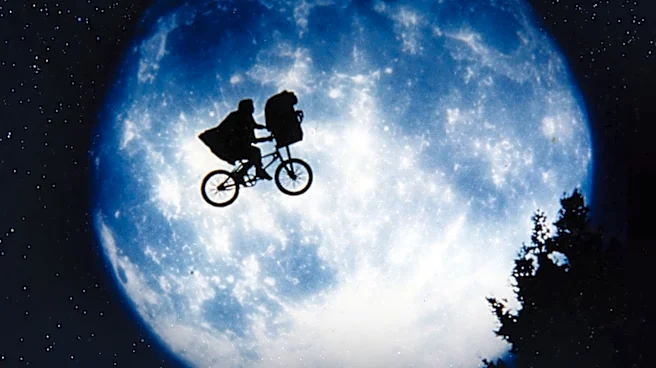
Southern California, these natural landscapes were utilized for critical scenes, including the opening UFO landing, E.T.'s near-death experience, and portions of the climactic Halloween night bicycle chase. Filming occurred from October to December 1981 under the working title 'A Boy's Life.' Cassandra Hesseltine, the film commissioner for Humboldt and Del Norte counties, noted that 'E.T.' was one of the first major films shot in the region, paving the way for future blockbusters. The film's production involved navigating challenging weather conditions and a tight budget, with Spielberg often 'winging it' on set rather than relying solely on storyboards. The character of E.T. was brought to life through a combination of puppetry and actors, and the iconic bicycle takeoffs were achieved using 'poor man's solutions' involving ropes and sound stages, with Northern California's night skies and trees providing the background.
Why It's Important?
The use of Northern California's unique natural landscapes for 'E.T.' highlights the region's historical significance as a versatile and appealing location for major film productions. This early adoption of the area for a high-profile film like 'E.T.' helped establish its reputation, influencing subsequent blockbusters to choose the redwoods for their 'ethereal' or 'epic' backdrops. The film's success, which became the highest-grossing film of its time and won four Academy Awards, demonstrated the effectiveness of integrating natural environments into storytelling, even for science fiction. The behind-the-scenes challenges, such as budget constraints and the reliance on practical effects, underscore the ingenuity and collaborative spirit prevalent in filmmaking during that era. The film's lasting cultural impact, including its ability to resonate with audiences through themes of connection and loss, is partly rooted in the authentic and immersive settings provided by the Northern California redwoods, making the alien's hiding place feel believable and isolated.
What's Next?
While 'E.T.' was filmed decades ago, its legacy continues to influence the film industry and local communities. The Humboldt-Del Norte Film Commission continues to promote the region as a filming destination, building on the precedent set by 'E.T.' The film's enduring popularity means that locations associated with its production, like Palmer Westbrook Ranch, occasionally receive attention from fans. The story of 'E.T.'s' production also serves as a case study in film history, illustrating how creative solutions and a strong vision can overcome logistical hurdles. Future film productions may continue to seek out Northern California's natural beauty, drawing inspiration from how 'E.T.' effectively utilized these landscapes to create a timeless cinematic experience. The film's impact on pop culture, including the surge in Reese's Pieces sales, demonstrates the powerful economic and cultural ripple effects a successful movie can have.
Beyond the Headlines
The story of 'E.T.'s' filming in Northern California delves into the deeper implications of how personal narratives can be woven into genre films. Director Steven Spielberg's personal connection to the script, mirroring his own childhood experiences with divorced parents, contributed to the film's emotional depth and universal appeal. The film's success, despite initial low polling and a challenging production, suggests that audiences respond strongly to stories that blend fantasy with relatable human emotions. The character of Keys, the lead scientist, was intentionally developed to be more nuanced than a typical antagonist, reflecting a desire to portray science and adults not as enemies, but as complex figures capable of empathy. This approach, combined with the film's hopeful message about connection across differences, contributed to its status as a 'fable' for its generation, teaching about life's challenges and the importance of letting go, encapsulated in the fading rainbow imagery at the film's conclusion.