




What's Happening?
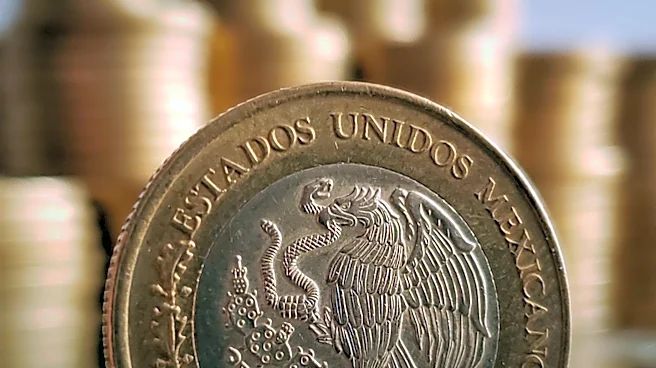
Economist Mariana Mazzucato has analyzed Mexico's economy through 'Plan Mexico,' a strategy designed by Mexican President Claudia Sheinbaum's government to boost growth. Mazzucato, director of the Institute for Innovation and Public Purpose at University
College London, co-authored a study titled 'State Transformation for Plan Mexico: A Mission-Oriented Approach to Achieving Shared Prosperity.' The study advocates for the Mexican state to drive the country's development through innovation, emphasizing greater coordination across government institutions and stronger public and private investment. Mazzucato highlights several challenges, including low tax revenues due to Mexico's tax structure, limited financing directed to the productive economy (only 35%), and weaknesses in the innovation system, where spending has historically been low. She stresses the importance for Mexico to evolve beyond being solely a low-cost manufacturer for U.S. companies and to develop its own technological and productive capabilities.
Why It's Important?
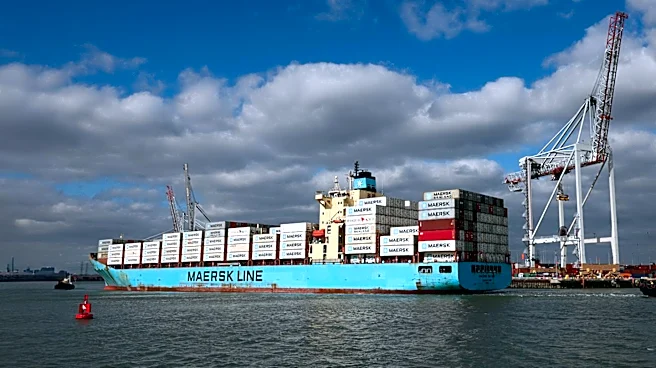
Mazzucato's recommendations carry significant weight for U.S.-Mexico economic relations and the future of the USMCA trade agreement. If Mexico successfully shifts its economic model from low-cost manufacturing to one driven by innovation and higher-value production, it could alter the dynamics of cross-border supply chains and trade. For U.S. companies that rely on Mexico for manufacturing, this could mean changes in operational costs, supply chain strategies, and potentially a need to adapt to a more technologically advanced Mexican industrial base. The call for tax reform and increased public investment in Mexico could also impact foreign direct investment from the U.S., as a more robust and equitable economic environment might attract different types of investments. Furthermore, a stronger, more independent Mexican economy could lead to a more balanced partnership within the USMCA, moving beyond a purely transactional relationship to one of shared innovation and development.
What's Next?
The implementation of 'Plan Mexico' under President Sheinbaum's administration will be a key area to watch. This includes potential tax reforms to increase revenue, efforts to redirect financing towards productive sectors, and increased funding for innovation. Mazzucato's report suggests that Mexico needs to strengthen its technological and productive capabilities, which could involve strategic investments in education, research and development, and infrastructure. The ongoing review of the USMCA trade agreement will also be critical, as Mexico seeks to integrate the three North American countries more deeply, moving beyond a free-trade zone to a more synergistic economic partnership. The success of these initiatives will depend on effective coordination between the Mexican government and the business community, as well as the ability to attract and retain both domestic and international investment in higher-value industries.
Beyond the Headlines
Mazzucato's critique of Mexico's economic structure touches upon broader issues of global economic inequality and the challenges faced by developing nations in moving up the value chain. The emphasis on state-led innovation and strategic public investment challenges traditional neoliberal approaches, suggesting that a more active government role is necessary to foster sustainable and inclusive growth. This perspective has implications for how international trade agreements, like the USMCA, are structured and how they can either perpetuate existing economic hierarchies or facilitate genuine development. The idea that Mexico should not merely be a 'low-cost manufacturer' for U.S. companies speaks to a desire for greater economic sovereignty and self-determination, which could reshape geopolitical and economic relationships in North America. The ethical dimension of ensuring equitable growth and addressing regional disparities within Mexico is also a crucial underlying theme.