







What's Happening?
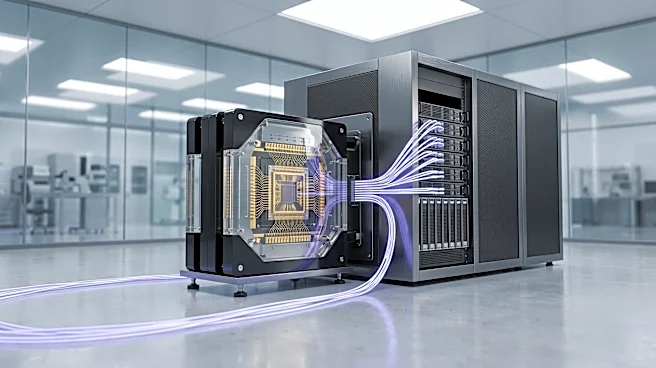
IonQ announced a significant advancement in quantum computing by demonstrating the industry's first end-to-end real-time quantum error decoder. This technology allows a single processor to identify, correct, and decode errors continuously while the quantum machine
operates, addressing a long-standing challenge in the field. Previously, errors accumulated faster than paused correction routines could manage, making quantum machines more like demonstrations than functional computers. This breakthrough moves the error decoder from theoretical concepts to a working device. Despite this engineering first, IonQ's stock experienced a mixed reaction, with an intraday jump of up to 13% on the news, but closing with a more modest gain of 4.42% for the day and 15.47% over the week. However, the stock remains down 43.39% over the past year and 5.19% year-to-date, indicating that the market is treating the news as a relief rally rather than a significant repricing event. The company reported $80.05 million in Q2 revenue and projects a full-year range of $280 million to $290 million, against a market capitalization near $17.23 billion and a price-to-sales multiple of 66.97. Adjusted EBITDA for Q2 was negative $120.3 million, with a full-year 2026 adjusted EBITDA loss guidance of -$310 million to -$330 million.
Why It's Important?
This breakthrough in real-time quantum error decoding is crucial for the practical application and scalability of quantum computing. Qubit decoherence and error accumulation have been major hurdles preventing quantum machines from moving beyond experimental stages to reliable, working devices. By enabling continuous, background error correction, IonQ's technology could significantly enhance the stability and performance of quantum computers, making them more viable for complex computational tasks. This development has the potential to accelerate the transition of quantum computing from a research curiosity to a powerful tool for various industries, including cryptography, drug discovery, materials science, and financial modeling. The mixed stock performance, however, highlights the ongoing challenge for quantum computing companies to translate technological advancements into sustainable commercial success and profitability. While the technical bottleneck may be solved, the commercial model remains a significant hurdle, with high cash burn rates and substantial losses against revenue. This situation underscores the speculative nature of investments in emerging high-tech sectors, where groundbreaking innovations do not always immediately translate into market confidence or financial returns.
What's Next?
IonQ's immediate next steps involve a 256-qubit commissioning campaign and the integration of its $1.8 billion Skywater acquisition, with a manufacturing ramp projected for the first half of next year. These efforts are critical to moving the error decoder from a demonstration to a repeatable enterprise solution. The company will need to secure significant commercial contracts to bridge the gap between its substantial market capitalization and its current revenue. Given the high cash burn rate common in the quantum computing industry, another capital raise is likely in the future, as the company closed a $2 billion equity offering last October. The market's reaction to this breakthrough suggests a 'winner-take-most' scenario in quantum computing, or that funds are financing IonQ by selling off shares in competitors. This implies that future market movements for IonQ and its rivals, such as Rigetti Computing and D-Wave Quantum, will be closely watched for signs of market consolidation or divergence. The ultimate success of IonQ will depend on its ability to convert its technical leadership into substantial commercial contracts and a sustainable revenue engine.
Beyond the Headlines
The development of a real-time quantum error decoder has profound implications beyond immediate commercial gains. It represents a fundamental shift in the feasibility of fault-tolerant quantum computing, which is essential for tackling problems currently intractable for even the most powerful classical supercomputers. This advancement could unlock new frontiers in scientific research, enabling simulations and calculations that were previously impossible, thereby accelerating discoveries in fields like medicine, materials science, and artificial intelligence. Ethically, the enhanced capabilities of quantum computers raise questions about data security and cryptography, as they could potentially break existing encryption standards. Legally, the intellectual property surrounding such breakthroughs will be fiercely contested, shaping the competitive landscape of the quantum industry. Culturally, the increasing power of quantum computing could lead to a re-evaluation of what is computationally possible, influencing how society approaches complex challenges and fostering a new era of technological innovation. The long-term shift could see quantum computing becoming an indispensable tool, complementing classical computing rather than entirely replacing it, particularly for highly specialized and computationally intensive tasks.