





What's Happening?
Lucid Group (NASDAQ:LCID) shares experienced a significant decline of 7.78%, trading at $4.27. This downturn is primarily attributed to investor concerns over the company's substantial cash burn, despite reporting strong year-over-year revenue growth
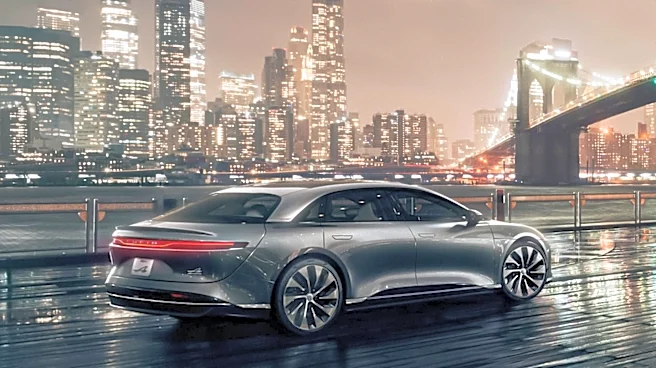
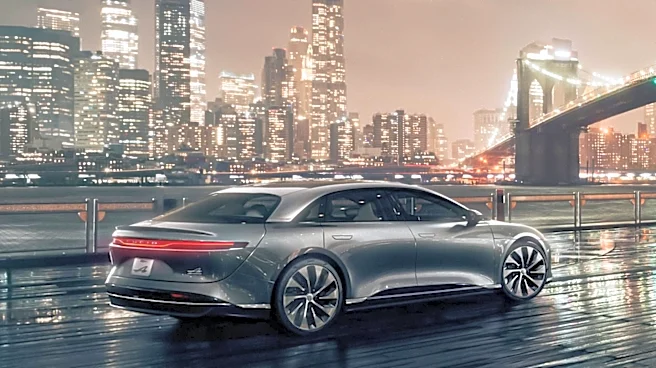
and increased vehicle deliveries. The recent quarterly report highlighted a net loss of $1.13 billion and a negative free cash flow of $1.44 billion. Although revenue reached approximately $405 million, surpassing estimates by 6.22%, and adjusted EPS loss of $2.78 beat the estimated loss of $3.12, the deeply negative gross margin of 105% and negative adjusted EBITDA of $901 million underscore ongoing financial challenges. The company, headquartered in Newark, California, designs, engineers, manufactures, and sells premium electric vehicles, including the Lucid Air sedan and Lucid Gravity SUV, and is a subsidiary of Ayar Third Investment, backed by Saudi Arabia's Public Investment Fund.
Why It's Important?
The continued financial struggles of Lucid Group, an American electric vehicle manufacturer, highlight the significant capital intensity and operational challenges within the EV industry. Despite a premium product offering and technological advancements, the company's inability to achieve profitability and positive cash flow raises questions about the long-term viability of EV startups that rely heavily on investor funding. The market's focus on cash burn over revenue growth indicates a shift in investor sentiment towards profitability and financial sustainability, especially in a broader risk-off environment for consumer discretionary stocks. This situation could influence investment decisions across the EV sector, potentially making it harder for other capital-intensive startups to secure funding if they cannot demonstrate a clear path to profitability. The company's efforts to improve cash flow through workforce reductions and strategic projects are critical for its survival and could serve as a case study for other emerging EV manufacturers.
What's Next?
Lucid Group's new CEO, Silvio Napoli, has outlined a comprehensive $1.4 billion cash flow improvement plan by year-end 2026. This plan includes workforce reductions, which are projected to generate $158 million in annualized savings, and focuses on four key projects: the Uber and Nuro robotaxi initiative, the completion of the AMP2 factory in Saudi Arabia, and the launch of a midsize platform. The company expects liquidity to extend well into 2027, supported by these planned savings. However, forward guidance indicates that production in the third and fourth quarters will fall below second-quarter levels due to a shift to a single-shift configuration. While deliveries are expected to grow sequentially, this growth will be more moderate than in the prior year as existing inventory is converted. Investors will be closely watching for formal 2027 guidance and mid-term targets, which are expected to be provided at year-end results, to assess the credibility of the company's path to improved unit economics and reduced cash burn.
Beyond the Headlines
The challenges faced by Lucid Group extend beyond immediate financial metrics, touching upon the broader strategic landscape of the premium electric vehicle market. The company's emphasis on luxury, advanced battery architecture, and proprietary software positions it uniquely, but also demands continuous, significant investment in R&D and manufacturing. The market's current skepticism, despite strong product appeal, underscores a critical tension: how to balance ambitious technological innovation and market differentiation with the imperative for financial discipline and operational efficiency. This situation could lead to a consolidation within the EV sector, favoring companies with deeper pockets or more established manufacturing capabilities. Furthermore, the reliance on external funding, particularly from entities like Saudi Arabia's Public Investment Fund, highlights the global nature of capital flows into high-growth, high-risk industries and the geopolitical implications of such investments in critical future technologies.