






What's Happening?
Lightmatter, a company specializing in AI data center infrastructure, has successfully raised $400 million in its Series D funding round. This latest investment brings the company's valuation to $4.4 billion. Lightmatter is known for its pioneering work
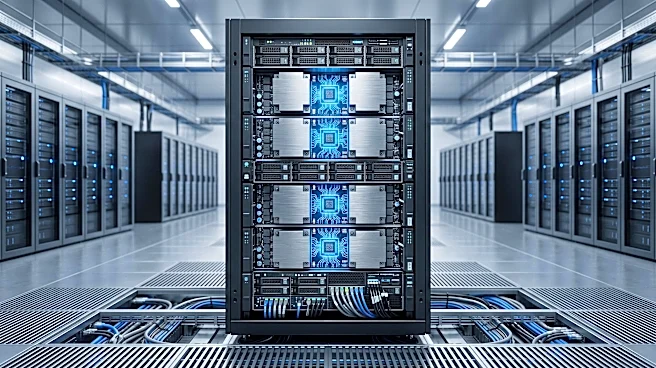
in photonic computing, having developed Passage™, the world's first 3D-stacked photonics engine. This technology is designed to connect a vast number of processors at the speed of light, catering to extreme-scale data centers that handle advanced AI and High-Performance Computing (HPC) workloads. The company plans to utilize the new capital to accelerate the development of its data center photonics technology and expand its various departments. Lightmatter is actively recruiting across multiple engineering levels, including Design Verification Engineers, to support its growth and innovation in the field of computing with light.
Why It's Important?
This significant funding round for Lightmatter underscores the growing demand and investment in advanced AI infrastructure. The company's photonic computing technology represents a potential paradigm shift in how data centers handle the increasing computational demands of AI and HPC. By enabling faster data transfer and processing through light, Lightmatter aims to overcome the limitations of traditional electronic computing, which could lead to more efficient and powerful AI systems. This development is crucial for U.S. industries heavily reliant on AI, such as technology, finance, and research, as it promises to enhance their capabilities and competitive edge. The expansion of Lightmatter also signifies job creation and technological advancement within the U.S. semiconductor and AI sectors, attracting top talent in engineering and scientific fields.
What's Next?
With the substantial capital infusion, Lightmatter is poised to intensify its research and development efforts in data center photonics. The company is expected to expand its workforce significantly, particularly in engineering roles, to further refine and deploy its innovative technologies. This will likely involve scaling up production of its photonic interconnect chips, co-packaged optics solutions, and other AI infrastructure hardware. Industry observers will be watching for Lightmatter's next product announcements and partnerships, as its technology could influence the future design and efficiency of large-scale data centers. The company's continued growth could also spur further investment and innovation in the broader photonic computing ecosystem, potentially leading to new industry standards and applications.
Beyond the Headlines
Lightmatter's success highlights a broader trend in the technology sector: the pursuit of alternative computing paradigms to meet the escalating demands of artificial intelligence. As Moore's Law faces physical limitations, photonic computing offers a promising path forward by leveraging light for computation and data transfer, which can be significantly faster and more energy-efficient than electrons. This shift has profound implications for sustainability in the tech industry, as more efficient data centers could reduce energy consumption and carbon footprints. Furthermore, the development of such advanced hardware could strengthen the U.S.'s position in the global AI race, reducing reliance on foreign technologies and fostering domestic innovation in critical computing infrastructure. The ethical considerations around the power and reach of advanced AI systems will also become more prominent as the underlying hardware becomes increasingly capable.