
What's Happening?
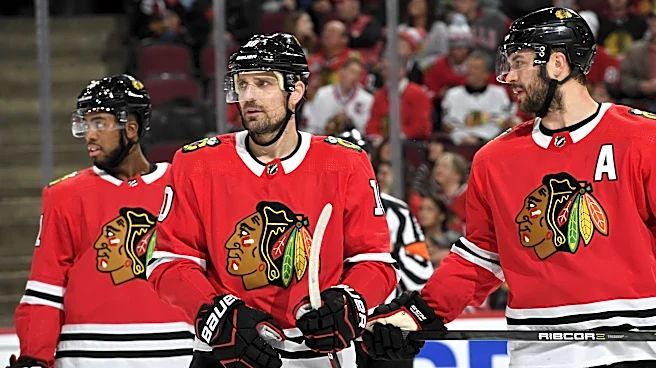
The Chicago Blackhawks are currently enduring a difficult NHL season, marked by a six-game losing streak and a 4-13-1 record. The team's struggles culminated in a 9-2 defeat against the Carolina Hurricanes,
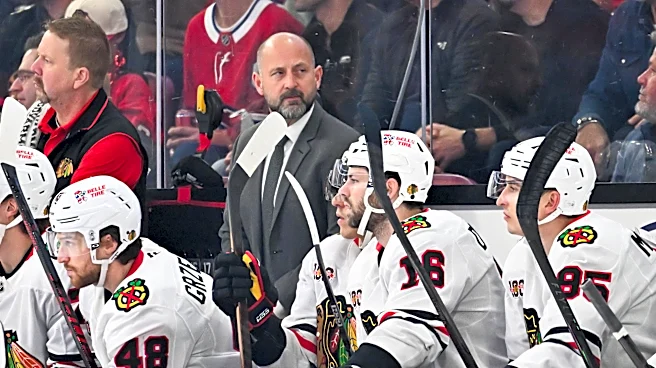
prompting a players-only meeting to address their performance. Head coach Jeff Blashill described the loss as a 'hard pill to swallow' and emphasized the need for the team to view it as a 'bottom point' from which to recover. The Blackhawks have allowed at least four goals in six consecutive games and in 11 of their 18 games overall, contributing to the worst point differential in the NHL at -37. Despite the challenging start, players like Connor Bedard have expressed that the team remains a 'tight-knit group' with belief in each other, though acknowledging that their performance has not met expectations. The team is tied with the Philadelphia Flyers for the fewest goals per game (2.17), with only Bedard (14 points) and Roman Kantserov (11 points) having more than 10 points, indicating a struggle to establish an offensive identity.
Why It's Important?
The Chicago Blackhawks' current predicament highlights the significant challenges faced by sports franchises undergoing a rebuild, particularly in a league as competitive as the NHL. For a team with a storied history, including three Stanley Cup titles between 2008 and 2017, this prolonged period of underperformance can impact fan engagement, sponsorship deals, and the overall market value of the franchise. The team's inability to convert high draft picks into immediate success, despite having a generational talent like Connor Bedard, raises questions about player development strategies and management decisions. The continuous losses and poor goal differential could lead to decreased attendance and viewership, affecting local businesses that benefit from game-day traffic and team-related merchandise sales. Furthermore, the pressure on management and coaching staff intensifies, potentially leading to significant organizational changes if the team cannot reverse its fortunes. The situation also affects player morale and the team's ability to attract future talent, as top players often seek competitive environments.
What's Next?
The Chicago Blackhawks are looking to use their recent players-only meeting and upcoming practice days to reset and improve their performance. Head coach Jeff Blashill has stressed the importance of making the recent blowout loss a turning point for the season. The team will need to address its defensive vulnerabilities, which have seen them concede at least four goals in six straight games, and work on developing a more consistent offensive strategy beyond the contributions of Connor Bedard and Roman Kantserov. The performance in the coming weeks will be crucial in determining the immediate future of the coaching staff and general manager Kyle Davidson, who have faced calls for change due to the team's prolonged struggles. The development of other high draft picks from recent years, such as Artyom Levshunov, Anton Frondell, and Kevin Korchinski, will also be under scrutiny as the organization seeks to build a competitive roster around Bedard. The team's ability to demonstrate progress will be vital for maintaining fan support and confidence in the ongoing rebuild.
Beyond the Headlines
The Blackhawks' current struggles extend beyond mere on-ice performance, touching upon the broader implications of a prolonged rebuild for an Original Six franchise. The team's rapid decline from an NHL elite to one of the league's bottom teams, with only one playoff appearance in the last nine seasons, underscores the difficulty of sustaining success in professional sports. The narrative of a 'rebuild hitting a wall' suggests that while draft picks are crucial, they are not a guaranteed path to recovery without complementary strategies in trades, free agency, and cap management. Questionable moves, such as the acquisition of TJ Brodie and Patrick Kane's recent contract, highlight potential missteps in roster construction and financial allocation. The trade of Seth Jones, despite his subsequent success elsewhere, further exemplifies the challenges in making sound long-term decisions during a rebuild. This situation raises ethical considerations regarding player welfare and the psychological toll of continuous losing, even for a tight-knit group. The long-term impact on the franchise's legacy and its ability to attract and retain top talent will depend on how effectively they navigate these deep-seated issues.