






What's Happening?
South Korean Prime Minister Han Seong-sook has called for enhanced high-tech collaboration between South Korea and Germany, specifically in the fields of batteries, semiconductors, and industrial artificial intelligence (AI). Speaking at the 19th Asia-Pacific
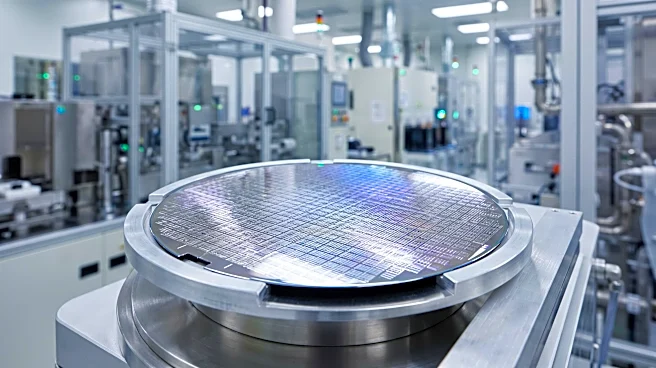
Conference of German Business (APK 2026) in Seoul, Prime Minister Han emphasized that these areas are crucial for future growth amidst increasing global economic uncertainty. She highlighted the significant expansion of bilateral economic ties, with trade growing from $2.9 billion to $30.9 billion over the past four decades, and cumulative mutual investment reaching $30.3 billion. Prime Minister Han pointed to Korean manufacturers' battery production bases in Poland and Hungary, which supply a substantial portion of Europe's battery cells, as key to Germany's electric vehicle transition. She also noted the opening of German optics giant Zeiss's first global innovation center in Yongin, Gyeonggi Province, as an example of growing semiconductor cooperation. The Prime Minister stressed the importance of integrating the two countries' manufacturing expertise and industrial data to boost productivity, quality, and energy efficiency.
Why It's Important?
This push for deeper high-tech cooperation between South Korea and Germany is significant for several reasons. It reflects a broader global trend of nations seeking to diversify partnerships and strengthen supply chains in critical technologies, particularly in response to escalating trade tensions and geopolitical uncertainties. For the U.S., this collaboration could have indirect implications by influencing global technology standards and supply chain resilience. Stronger alliances among democratic, technologically advanced nations like South Korea and Germany could contribute to a more stable international economic environment, potentially benefiting U.S. businesses and consumers through more reliable access to advanced components and innovations. The focus on industrial AI, semiconductors, and batteries addresses key sectors that are vital for economic competitiveness and national security, aligning with U.S. interests in securing these technologies. Furthermore, the emphasis on 'trusted interdependence' rather than self-sufficiency in supply chains suggests a model that could be adopted by other nations, including the U.S., to build more robust and secure economic relationships.
What's Next?
Following the discussions at APK 2026, South Korea and Germany are expected to implement the upgraded enhanced strategic partnership and the economic and high-tech partnership framework signed during the event. This will likely lead to increased joint research and development in critical future industries such as AI, quantum computing, biotechnology, and space. Both governments are committed to providing stronger support for their respective businesses to expand their presence across the Asia-Pacific region and Europe. This could translate into new investment opportunities, technology transfer initiatives, and collaborative projects aimed at establishing new global standards in AI-driven manufacturing. The ongoing efforts to integrate industrial data and manufacturing expertise will likely involve working groups and pilot programs to develop and deploy advanced technologies. The success of these initiatives could serve as a blueprint for other international collaborations in high-tech sectors.
Beyond the Headlines
The call for deeper high-tech ties between South Korea and Germany extends beyond immediate economic benefits, touching upon the evolving landscape of global governance and technological leadership. In an era marked by increasing protectionism and geopolitical competition, such partnerships underscore a strategic alignment among like-minded nations to collectively address complex challenges. The concept of 'trusted interdependence' in supply chains, as articulated by South Korean Industry Minister Kim Jung-kwan, suggests a shift away from purely nationalistic approaches towards a more collaborative and resilient global economic order. This could foster a more ethical and responsible development of AI and other advanced technologies, emphasizing human oversight and safety as AI integrates into physical environments. The collaboration also highlights the importance of shared values and democratic principles in shaping technological advancements and ensuring equitable access to innovation, potentially influencing international norms and standards for responsible technology use.