




What's Happening?
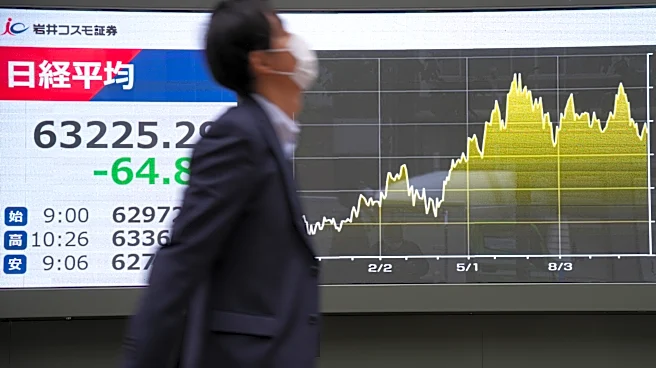
Asian markets, particularly those in Seoul and Tokyo with significant AI-linked technology companies, are increasingly acting as proxies for global risk-on and risk-off sentiment, especially in response to U.S. market events. According to Asia Times,
these markets are the first to open after the U.S. close, making them natural venues for global traders' overnight macro trades. This dynamic leads to significant price movements in these Asian stocks, often disproportionate to their underlying fundamentals. The article highlights that large, near-trillion-dollar stocks in these regions can move like 'meme stocks' due to algorithmic trading and the 'tyranny of the marginal dollar,' where a small amount of trading capital at the open can set prices for the day. This phenomenon is driven by a 'second generation' of algorithms that react to the initial price movements set by 'first generation' algorithms, which interpret news within milliseconds.
Why It's Important?
This trend has significant implications for U.S. investors and the global financial system. The rapid and often exaggerated price movements in Asian markets, influenced by U.S. tech news and macro events, can create ripple effects that impact U.S. equity futures and investor sentiment before U.S. markets even open. The article suggests that fundamental investors, who typically provide stability, are often absent during these early hours, allowing algorithms to dominate price discovery. This can lead to increased volatility and a disconnect between a company's actual value and its stock price, making it challenging for long-term investors to make informed decisions. The 'tyranny of the marginal dollar' means that the price of a stock can be set by a small fraction of trading activity, rather than a broad consensus of value.
Beyond the Headlines
The article delves into the deeper implications of this market behavior, suggesting that companies are inadvertently taking on an 'extra line of business' by supplying trading capacity for global macro views, rather than solely reflecting their own business prospects. This shift raises questions about market efficiency, fairness, and the role of regulation. The author notes that regulators often focus on familiar suspects like short sellers or manipulators, but the issue of how prices are set at the open by high-speed, opinion-agnostic trading remains largely unaddressed. The long-term consequence is a potential erosion of confidence among fundamental investors, who find their opinions and capital increasingly irrelevant in the face of rapid, algorithm-driven price swings. This could lead to a less stable and less fundamentally driven market environment globally, including for U.S. companies with significant international exposure.