





What's Happening?
Tony Xu, CEO of DoorDash, has articulated the significant hurdles involved in expanding autonomous delivery services. He emphasized that the complexity lies in effectively integrating operational logistics with advanced technology to achieve scalable
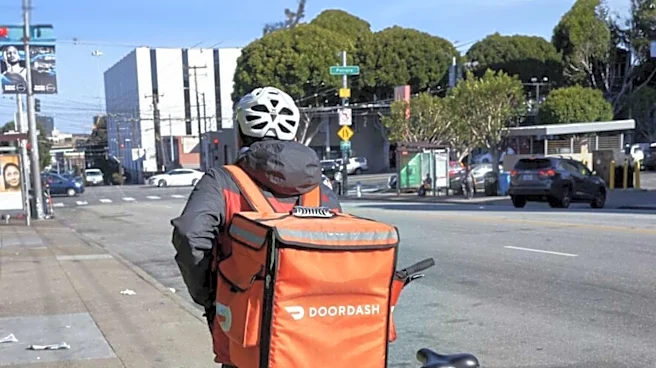
autonomous delivery. Xu pointed out several practical problems that complicate this integration, including the process of loading orders at merchant locations, accurately estimating restaurant preparation times, navigating interactions with high-rise doormen, and managing gate codes at apartment complexes. These issues underscore the intricate real-world scenarios that autonomous delivery systems must overcome to become a viable and widespread solution. His comments suggest that while technological advancements are crucial, the operational aspects present a unique set of challenges that require careful consideration and innovative solutions.
Why It's Important?
The insights from DoorDash CEO Tony Xu are important for the U.S. delivery and logistics industry, as they highlight the practical barriers to widespread autonomous delivery. While the promise of autonomous vehicles offers potential cost savings and efficiency gains, Xu's remarks indicate that these benefits are not easily realized. The challenges he outlined, such as loading logistics and navigating complex urban environments, directly impact the scalability and reliability of autonomous delivery services. This perspective suggests that companies investing in this technology, including DoorDash and its competitors, must prioritize robust operational integration alongside technological development. The success or failure in overcoming these challenges will determine the pace of adoption for autonomous delivery, influencing labor markets, infrastructure development, and consumer expectations for delivery services across the U.S.
What's Next?
Addressing the challenges outlined by Tony Xu will likely involve continued investment in advanced robotics and artificial intelligence, specifically tailored to handle the intricacies of real-world delivery environments. DoorDash and other companies in the autonomous delivery sector will need to develop more sophisticated systems for tasks like precise item handling, dynamic route optimization that accounts for unexpected delays, and seamless communication protocols with various building access systems. Furthermore, partnerships with technology providers and urban planners may become crucial to create standardized solutions for issues such as loading dock access and secure package drop-off in multi-unit dwellings. The industry can expect to see pilot programs focusing on these specific operational pain points, with a gradual rollout of autonomous delivery services in controlled environments before broader expansion. Regulatory frameworks will also need to evolve to accommodate these new delivery methods, ensuring safety and efficiency.
Beyond the Headlines
The challenges in scaling autonomous delivery, as articulated by Tony Xu, extend beyond mere technological hurdles to touch upon deeper societal and economic implications. The integration of autonomous delivery systems could significantly alter the landscape of urban employment, potentially displacing human delivery drivers while creating new jobs in maintenance, oversight, and software development. There are also ethical considerations regarding the interaction of autonomous robots with the public, particularly in crowded urban spaces, and questions about liability in case of accidents or delivery failures. Furthermore, the success of autonomous delivery could exacerbate existing inequalities, with potential benefits primarily accruing to urban centers and wealthier demographics who can afford premium delivery services, while rural areas might see slower adoption. The 'pain and suffering' Xu refers to might also encompass the societal adjustments required to adapt to a new paradigm of automated services, prompting discussions about the future of work and the role of technology in daily life.