




What's Happening?
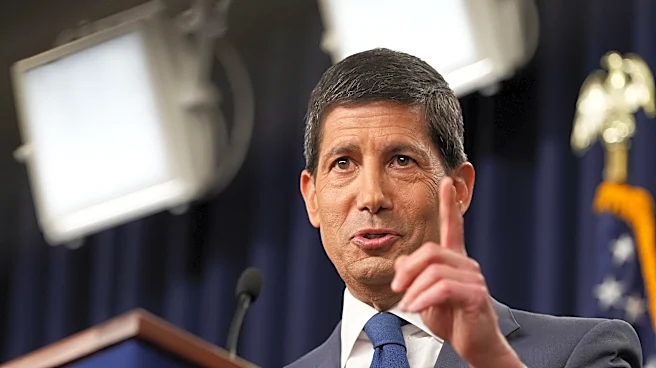
Economist David Rosenberg, founder and president of Rosenberg Research, argues that the U.S. economy is significantly weaker than suggested by strong market performance and headline earnings. Despite official definitions not classifying the current situation
as a recession, Rosenberg points to several indicators of underlying fragility. Real GDP growth has averaged below 1.5% for three consecutive quarters, with a fourth expected, falling short of the Federal Reserve's 2% potential growth estimate. He highlights that real disposable personal income is fractionally negative year-over-year, and there has been no employment growth over the past 12 months. Rosenberg contends that the strength seen in the economy is heavily concentrated in the artificial intelligence (AI) sector, masking weaknesses elsewhere. He also suggests that the Federal Reserve's next move will be a rate cut, rather than a hike, as it shifts focus from inflation to a weakening labor market. This perspective contrasts with the general consensus that the economy is resilient.
Why It's Important?
Rosenberg's analysis is important because it challenges the prevailing optimistic narrative about the U.S. economy, suggesting that current economic strength is superficial and unsustainable. If his assessment is accurate, it implies that many businesses and consumers are operating under false pretenses of stability, potentially leading to unexpected economic downturns. The reliance on AI spending to drive economic growth, while other sectors like housing and commercial construction remain weak, indicates a 'K-shaped' recovery where benefits are not broadly distributed. This could exacerbate wealth and income inequality, leading to social and political instability. Furthermore, his prediction of a Fed rate cut, contrary to market expectations for further hikes, could significantly impact investment strategies, bond markets, and the overall financial landscape, as investors may need to re-evaluate their positions based on a more pessimistic economic outlook.
What's Next?
Rosenberg anticipates that the Federal Reserve will eventually shift its focus from inflation, which he believes is heading lower due to building economic slack, to the weakening labor market. This shift would likely trigger a rate cut, potentially making two- and three-year notes attractive to investors. He suggests that the current market pricing for at least one more rate hike will likely be reversed. Businesses and consumers should monitor real GDP trends, the personal savings rate, and corporate profits outside of the AI and energy sectors for clearer indications of economic health. If the stock market's upward trajectory falters or the personal savings rate stops declining, consumer spending, which has been propped up by these factors, could converge with flat real incomes, potentially widening the gap between aggregate supply and demand and increasing the likelihood of a more pronounced economic slowdown.
Beyond the Headlines
The deeper implications of Rosenberg's argument highlight a bifurcated economy where the booming AI sector disproportionately influences headline figures, obscuring fragility in other areas. This 'K-shaped' economic growth, where certain sectors and demographics thrive while others struggle, raises ethical questions about equitable distribution of economic benefits and the long-term sustainability of such a model. The reliance of consumer spending on the 'equity wealth effect' rather than real income growth suggests a precarious foundation for household finances, vulnerable to stock market corrections. This situation could lead to increased social unrest and political polarization, as disparities in wealth and opportunity become more pronounced. The potential for a significant economic re-evaluation, driven by a shift in the Fed's policy and a more realistic assessment of underlying economic health, could trigger a broader societal reckoning with the true state of economic well-being in the U.S.