







What's Happening?
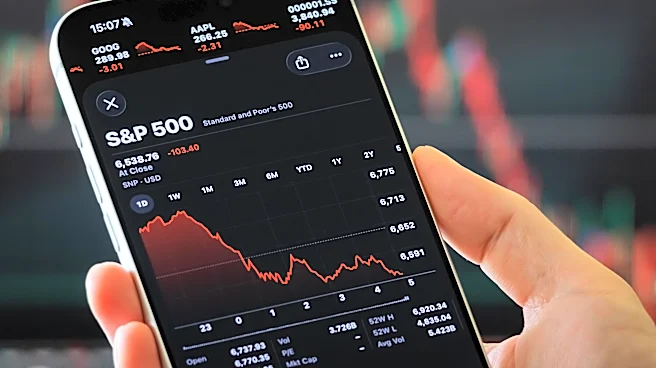
Jeremy Siegel, an emeritus finance professor at the Wharton School and chief economist at WisdomTree, asserts that the recent market downturn is primarily a correction in technology stocks rather than an indicator of broader economic issues. In his weekly
commentary from November 23, Siegel expressed optimism for 2027, anticipating a resurgence in value-oriented stocks. He believes that fears of significant interest rate hikes are overstated, particularly a half-percentage point increase in December, due to moderating energy prices that are expected to curb inflation. Siegel, known for his book 'Stocks for the Long Run,' suggests that once interest rate anxieties subside, favorably valued substance stocks will regain their relative strength. He had previously predicted a 20-30 percent correction for the Nasdaq by late October, while estimating a smaller decline for the S&P 500 than what ultimately occurred.
Why It's Important?
Siegel's perspective offers a counter-narrative to market panic, suggesting that the current volatility is a sector-specific correction rather than a systemic economic problem. His forecast for a comeback in value stocks could influence investment strategies, encouraging a shift away from an exclusive focus on large technology companies. For U.S. investors, this implies a potential opportunity in diversified portfolios, particularly those tracking equally weighted indices like the S&P 500, which are less concentrated in tech giants. If Siegel's prediction of stable interest rates due to falling energy prices holds true, it could alleviate concerns about borrowing costs for businesses and consumers, potentially supporting broader economic stability and growth. His insights, derived from extensive academic and advisory experience, provide a significant viewpoint for market participants navigating current economic uncertainties.
What's Next?
Investors will likely monitor energy prices and inflation data closely to see if they align with Siegel's prediction of dampened inflation, which would support his view against aggressive interest rate hikes. The performance of value stocks versus growth stocks, particularly in the technology sector, will be a key indicator of whether his anticipated comeback materializes. Financial advisors and fund managers may consider rebalancing portfolios to include more value-oriented assets, following Siegel's recommendation to diversify beyond large technology holdings. The Federal Reserve's upcoming decisions on interest rates will be crucial in validating or challenging Siegel's assessment of the market's trajectory and the broader economic outlook for 2027.
Beyond the Headlines
Siegel's emphasis on value stocks and diversification highlights a potential long-term shift in investment philosophy, moving away from the concentrated growth-stock dominance seen in recent years. This could lead to a re-evaluation of market fundamentals, where intrinsic value and stable earnings become more attractive than speculative growth. The debate between technology-driven growth and traditional value investing also touches upon broader economic narratives about innovation versus stability. If his predictions prove accurate, it could reinforce the importance of fundamental analysis and long-term investment horizons, potentially influencing financial education and investor behavior for years to come. His role as an academic and advisor, rather than a fund manager, lends a certain objectivity to his analysis, focusing on broader market trends and economic principles.