




What's Happening?
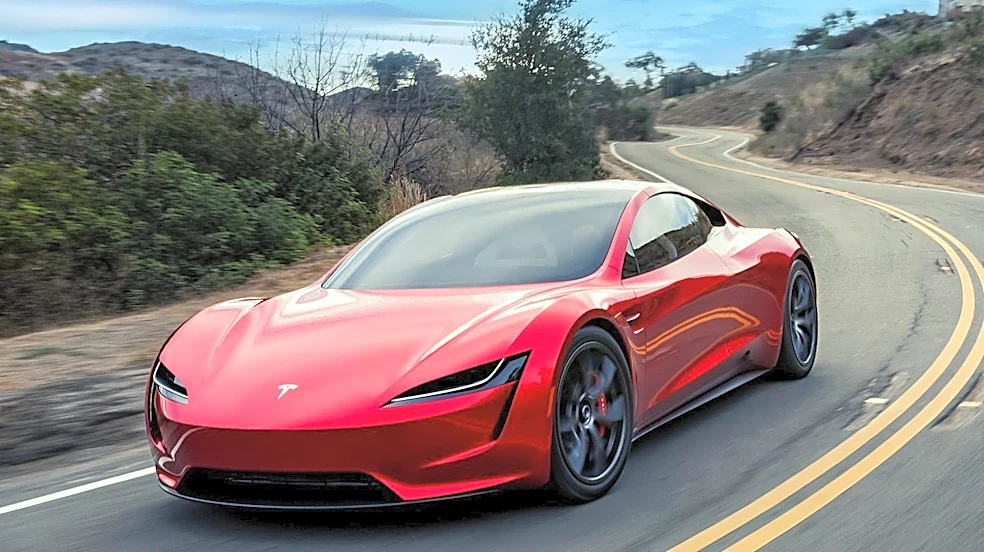
Tesla has revealed its second-generation Roadster, showcasing a dramatically different design from its 2017 concept and demonstrating extreme capabilities through a series of stunts. The vehicle was shown holding itself nearly upside down on a ramp using
fan-supplied downforce, performing a barrel roll after driving off a ramp with a cold gas booster propulsion system, and completing a 'kickflip' jump over other Tesla models, including a semi-truck, also utilizing boosters. The most notable performance claim is a 0-60 mph acceleration in 0.81 seconds, achieved with a rear-mounted booster system. Tesla specifies that the aerial stunts are possible only with a 'Rocket' variant, a single-seat, non-road-approved model available by invite, while the sub-second acceleration is attributed to a 'Thrust' model, a limited-release version with rear boosters. All stunts were performed physically in front of a live audience, though Tesla did not confirm if the demonstrators were production models.
Why It's Important?
These demonstrations push the boundaries of what is conventionally expected from a production vehicle, potentially redefining performance benchmarks in the automotive industry. The use of fan-assisted downforce and cold gas booster systems represents significant technological advancements, even if some features are limited to specialized variants. The claimed 0-60 mph acceleration time, if achieved in a production model, would be unprecedented for a road car, setting a new standard for electric vehicle performance. This could intensify competition among electric vehicle manufacturers to innovate in speed, handling, and advanced propulsion systems. For consumers, these stunts create significant buzz and excitement around the Tesla brand, potentially driving demand for future high-performance electric vehicles and influencing the direction of automotive engineering and design.
What's Next?
Tesla's next steps will involve further development and testing of these advanced technologies, with a planned production date of 2028 for the Roadster. The company will need to address questions regarding the repeatability and practicality of these extreme stunts in consumer-ready vehicles, as well as the regulatory hurdles for non-road-approved variants. The market will closely watch for details on the 'Rocket' and 'Thrust' models, including their availability, pricing, and actual performance specifications. Competitors in the electric vehicle and high-performance car segments are likely to respond with their own innovations, potentially leading to an acceleration of technological advancements across the industry. The long-term impact will depend on Tesla's ability to translate these demonstrative capabilities into reliable, mass-produced vehicles that meet safety and performance expectations.
Beyond the Headlines
The Tesla Roadster's extreme stunts delve into the philosophical and engineering questions of automotive design: what is a car capable of, and what should it be? The integration of fan-assisted downforce and rocket-like boosters blurs the lines between traditional automobiles and aerospace technology, challenging conventional notions of vehicle performance and utility. This development could spark broader discussions about the future of transportation, including the potential for personal aerial vehicles or highly specialized ground vehicles that leverage advanced propulsion. Ethically, the focus on extreme speed and stunts raises questions about safety, environmental impact (even for electric vehicles, the energy consumption for such feats is high), and the responsible application of cutting-edge technology. Culturally, these demonstrations contribute to the ongoing narrative of technological progress and human ingenuity, pushing the boundaries of what is considered possible in the automotive world.