


What's Happening?
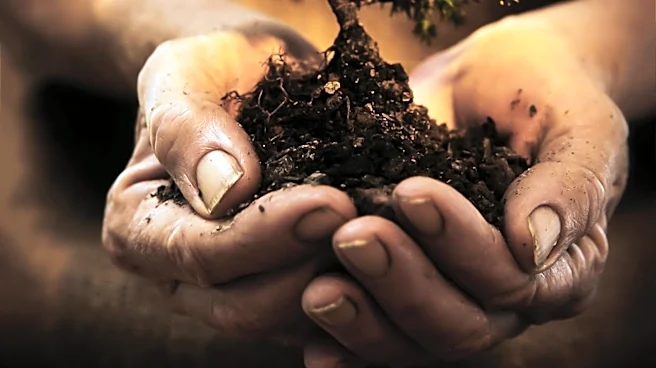
Hollywood actress Kim Novak, known for her roles in films like "Vertigo" and "Picnic," has revealed her wish to have her body composted after her passing. In a rare interview with PETA, Novak stated her hope that her friends would use her remains to plant
trees, expressing a desire to become part of a beautiful tree and to see the animals who have passed. Now 93, Novak lives on a ranch in Oregon and finds the idea comforting, viewing it not as a final farewell but as a continuation of life in nature. She shared that her retreat from Hollywood allowed her to surround herself with animals, which helped her discover more about herself, as animals cared less about her success or wealth and more about trust. This sentiment highlights her deep connection to nature and animal welfare, a focus she adopted after largely retiring from acting decades ago.
Why It's Important?
Kim Novak's public statement regarding her post-mortem wishes contributes to a growing conversation around alternative burial practices in the United States. Human composting, also known as natural organic reduction, is an environmentally friendly option that is gaining legal recognition in several states, including Washington, Colorado, Oregon, Vermont, and California. This method offers an alternative to traditional burial and cremation, which have significant environmental impacts. Traditional burials can involve embalming chemicals and non-biodegradable caskets, while cremation releases carbon emissions. Novak's choice, from a prominent public figure, could further normalize and popularize human composting, encouraging more individuals to consider eco-conscious end-of-life options. This shift could lead to increased demand for such services, potentially influencing policy changes and the expansion of facilities offering natural organic reduction across the nation, thereby reducing the environmental footprint associated with human remains.
What's Next?
The increasing visibility of figures like Kim Novak advocating for human composting is likely to accelerate the acceptance and legal adoption of this practice across more U.S. states. As public awareness grows, driven by environmental concerns and personal preferences for natural processes, more states may consider legislation to permit natural organic reduction. This could lead to a broader availability of human composting services, making it a more accessible option for the general public. Furthermore, the discussion initiated by Novak's wishes may prompt funeral homes and related industries to invest in and offer these alternative services, adapting to changing consumer demands. The long-term impact could be a significant shift in end-of-life practices, moving towards more sustainable and ecologically sound methods of disposition, aligning with broader environmental conservation efforts.
Beyond the Headlines
Kim Novak's decision to choose human composting transcends a mere personal preference; it reflects a deeper philosophical shift towards reconnecting with nature and challenging conventional societal norms surrounding death. Her desire to become a tree symbolizes a return to the earth and a continuation of life, embodying a profound ecological consciousness. This choice also highlights the evolving relationship between humans and the environment, particularly in the context of mortality. By embracing a natural process, Novak implicitly critiques the more artificial and resource-intensive methods of burial and cremation. Her advocacy for animal welfare, which she pursued after leaving Hollywood, further underscores her commitment to a holistic view of life and death, where all living beings are interconnected. This perspective encourages a re-evaluation of how society approaches death, promoting a more integrated and respectful interaction with the natural world.