







What's Happening?
Wai Man Book Binding has completed its relocation to a new 34,500-square-meter facility, which is 50% larger than its previous location. This expansion allows the company to significantly increase its production capacity, particularly for mini-books and
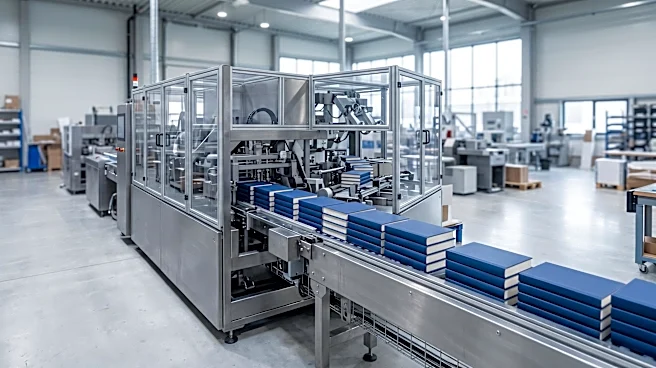
oversized formats. Managing director Nathan Lui reports that the company has been actively installing new machinery, optimizing production flows, and securing necessary accreditations and certifications to meet client requirements. Among the new additions are the latest Heidelberg MultiDot 2.0 screening technology for offset printing, customized automatic processing lines for wall calendars, wire-o lines for books and stationery, a Muller-Martini VBF hardcover machine, and robotic arms for pallet stacking. Wai Man Book Binding has also extended its logistics services to include hand-assembly, personalized packaging, and global batch deliveries, leveraging its extensive warehouse capabilities. The company is also developing an AI-enabled estimation system slated for launch next year.
Why It's Important?
The expansion and technological upgrades at Wai Man Book Binding are significant for the U.S. publishing and stationery industries, which often rely on overseas manufacturers for cost-effective and high-quality production. Increased capacity for specialized formats like mini-books and oversized editions means U.S. publishers can access a broader range of production capabilities, potentially leading to more diverse product offerings for the American market. The integration of advanced printing technologies, such as Heidelberg MultiDot 2.0, promises improved print quality, color stability, and efficiency, which translates to higher quality products for U.S. consumers. The development of an AI-enabled estimation system could streamline the quoting process, offering U.S. clients faster and more accurate pricing, thereby improving project planning and reducing potential discrepancies. Furthermore, enhanced logistics services, including personalized packaging and global batch deliveries, can optimize supply chains for U.S. companies, ensuring more efficient distribution and potentially reducing lead times for products reaching American shelves.
What's Next?
Wai Man Book Binding plans to launch its AI-enabled estimation system next year, which is expected to significantly shorten Request for Quotation (RFQ) turnaround times, improve pricing accuracy, and reduce human errors. The company will continue to leverage its expanded capacity to meet the demanding timelines of its calendar business, which produces over five million square calendars and two million wire-o desk and wall calendars annually. The new facility and its advanced machinery will also support ongoing projects, such as a Japanese client's mini-book project with blind box packaging, showcasing the company's capability in complex classification packaging and multi-location deliveries. The focus will remain on optimizing production flows and maintaining high-quality standards to serve its global clientele, including those in the U.S., with specialized printing and binding services.
Beyond the Headlines
The strategic investments by Wai Man Book Binding in larger facilities and cutting-edge technology highlight a broader trend in the manufacturing sector towards automation and digital transformation. The use of robotic arms for pallet stacking and an AI-enabled estimation system points to an industry moving towards greater efficiency and precision, reducing reliance on manual labor for repetitive tasks and enhancing data-driven decision-making. This evolution not only addresses operational challenges but also positions the company to meet the increasing demands for customization and speed in the global market. The company's expertise in lightweight printing for Bibles and mini-Bibles, combined with unique cover finishes, demonstrates a commitment to niche markets and specialized craftsmanship, suggesting that even with technological advancements, there remains a strong emphasis on quality and unique product offerings. This blend of tradition and innovation is crucial for maintaining competitiveness in a dynamic global printing landscape.