







What's Happening?
AST SpaceMobile, a telecommunications company based in Midland, Texas, reported a loss of 44 cents per share in its third-quarter 2026 results, missing the Zacks Consensus Estimate of a 41-cent loss. Despite a 187.1% year-over-year surge in revenues to
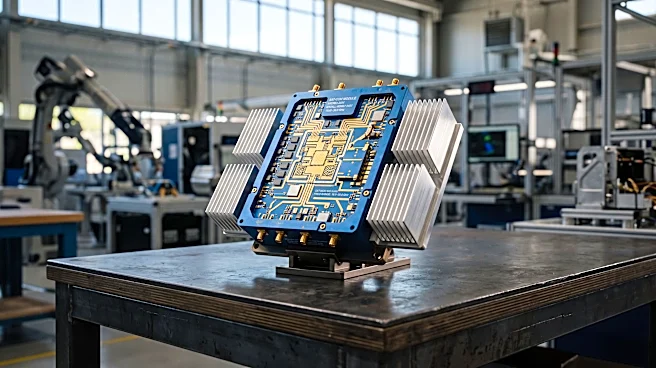
$42.32 million, the company fell short of the consensus estimate of $44.47 million. This revenue growth was primarily driven by commercial gateway deliveries and U.S. government contract milestones. However, elevated operating expenses, which increased by 123.5% to $211.03 million, significantly impacted profitability. These expenses include substantial investments in satellite manufacturing, workforce expansion, and network development, with engineering services costs rising to $95.79 million and general and administrative expenses increasing to $55.71 million. The company is accelerating its satellite manufacturing roadmap, integrating next-generation application-specific integrated circuit (ASIC) technology into its BlueBird 34 satellites, which is expected to deliver a 10-fold improvement in processing bandwidth compared to existing Block 1 satellites. AST SpaceMobile aims to have approximately 45 BlueBird satellites in orbit by mid-2027, with launch agreements for over 100 satellites by 2027 and 2028.
Why It's Important?
The financial performance of AST SpaceMobile is crucial for the U.S. telecommunications industry and its goal of bridging the digital divide. The company's mission to provide space-based broadband directly to standard smartphones without specialized hardware has the potential to revolutionize connectivity, particularly in underserved areas across the continental United States and Canada. A successful deployment of its BlueBird satellites could eliminate dead zones and enhance existing mobile networks, offering seamless service to millions. However, the recent earnings miss and rising expenditures raise concerns among investors about the company's ability to translate its technological advancements and deployment progress into sustainable recurring revenues and profitability. The high infrastructure setup costs and research and development expenses for sophisticated satellite technology mean that AST SpaceMobile will continue to incur significant expenditures. The market's skepticism, reflected in the downtrend of estimate revisions, highlights the need for greater clarity on the commercial-service ramp and the path toward improving operating leverage. The company's ability to overcome these financial hurdles will determine its long-term viability and its impact on global cellular coverage.
What's Next?
AST SpaceMobile plans to continue its aggressive satellite manufacturing and deployment schedule. The company is manufacturing satellites through BlueBird 51 at its Texas facilities, with two factories operating full shifts to produce six ASIC-enabled satellites monthly by December 2026. BlueBirds 14, 15, and 16 have already been shipped to Cape Canaveral, with additional shipments planned through January 2027. The company targets approximately 45 BlueBird satellites in orbit by mid-2027, with launch agreements covering more than 100 satellites for deployment during 2027 and 2028. Investors will be closely watching for signs of improved financial performance and clearer visibility regarding the commercial-service ramp and operating leverage. The successful launch and operation of these satellites, coupled with effective commercial partnerships, will be critical for AST SpaceMobile to demonstrate its ability to generate healthy recurring revenues and achieve profitability, ultimately transforming network connectivity and expanding its global presence.
Beyond the Headlines
The challenges faced by AST SpaceMobile extend beyond immediate financial results, touching upon the broader implications of pioneering space-based telecommunications. The company's reliance on highly sophisticated satellite technology and its ambitious deployment schedule highlight the significant capital and operational risks inherent in this sector. The integration of next-generation ASIC technology, while promising a 10-fold improvement in processing bandwidth, also underscores the continuous need for innovation and substantial R&D investment. The macroeconomic conditions, including inflation, interest rates, and geopolitical conflicts, further complicate the financial landscape, impacting material prices and capital costs. The long-term success of AST SpaceMobile could set a precedent for how global cellular coverage is achieved, potentially reshaping the competitive landscape of the telecommunications industry. However, the current investor caution suggests that the market is seeking more than just technological prowess; it demands a clear and executable path to commercial viability and sustained profitability in a highly capital-intensive and technologically complex domain.