





What's Happening?
Strength training, involving exercises to improve muscular strength and endurance through resistance, is recommended for general life purposes and complements cardiovascular work. It enhances daily activities such as carrying groceries and picking up
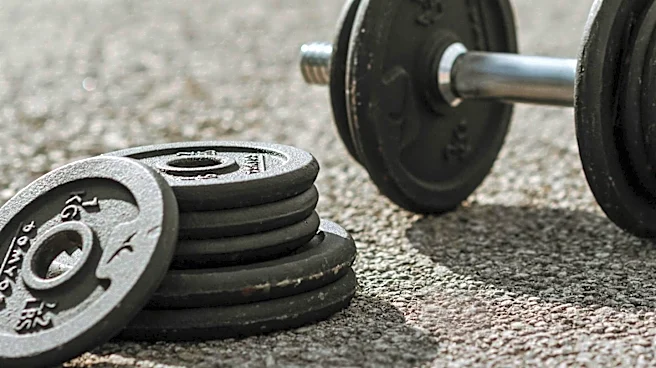
children. A recent systematic review and meta-analysis examined the effectiveness of free weights versus machine-based strength training across three outcomes: maximal strength, muscle hypertrophy, and jump performance. The study found no significant differences between the two training modalities in a direct comparison, even among advanced trainees. This challenges the common assumption that serious lifters must eventually transition to free weights for optimal results. The World Health Organization and the CDC recommend adults engage in 150 to 300 minutes of moderate-intensity activity per week, or 75 to 150 minutes of vigorous activity, in addition to muscle-strengthening work on two or more days per week. Strength training is also highlighted for its role in preserving bone density and muscle strength, particularly important for aging populations, and for reducing fall risk through balance training.
Why It's Important?
The findings from the meta-analysis are significant for the fitness industry and individuals alike. For gym operators, this research suggests that decisions regarding equipment investment, particularly the expansion of free weight areas, should be guided by member preference, available space, and operational considerations rather than perceived performance advantages. It indicates that a blend of both free weights and machines can be equally effective, and members who achieve consistency with selectorized equipment do not necessarily need to be pushed towards free weights. This insight can lead to more efficient allocation of resources and better-tailored fitness programs. For individuals, understanding that both free weights and machines offer comparable benefits for strength, muscle growth, and power can broaden access to strength training, making it more approachable for beginners and those with specific needs or preferences. The broader emphasis on strength training as a component of overall health, including its benefits for bone density, mobility, and mental well-being, underscores its critical role in public health.
What's Next?
The insights from this meta-analysis are likely to influence how fitness clubs design their facilities and educate their staff and members. Operators may re-evaluate their equipment purchasing strategies, potentially leading to a more balanced approach to gym layouts that incorporate both free weights and machines without prioritizing one over the other based on performance myths. Staff training programs may be updated to reflect these findings, challenging outdated assumptions about progression from machines to free weights. This could result in more inclusive and effective programming for members of all experience levels. Furthermore, as strength training continues to grow in popularity, there may be an increased focus on adherence strategies, such as encouraging individuals to choose modalities they enjoy, whether free weights or machines, to ensure long-term engagement and maximize health benefits. Public health campaigns may also leverage these findings to promote strength training more broadly, emphasizing its accessibility and diverse benefits.
Beyond the Headlines
The debate between free weights and machines extends beyond mere equipment choice; it touches upon the psychological aspects of fitness and the influence of industry trends. The persistence of the belief that advanced training requires free weights, despite evidence to the contrary, highlights how deeply ingrained certain fitness narratives can become. This can create unnecessary barriers for individuals who might benefit from strength training but are intimidated by free weight areas or prefer the guided movements of machines. By debunking this myth, the research promotes a more inclusive and evidence-based approach to fitness, potentially empowering more people to engage in strength training. Ethically, this shift encourages fitness professionals to prioritize individual needs and preferences over rigid, unproven training dogmas. Culturally, it could contribute to a broader understanding of fitness as a diverse and adaptable practice, rather than a one-size-fits-all endeavor, fostering greater participation and long-term health outcomes across various demographics.