




What's Happening?
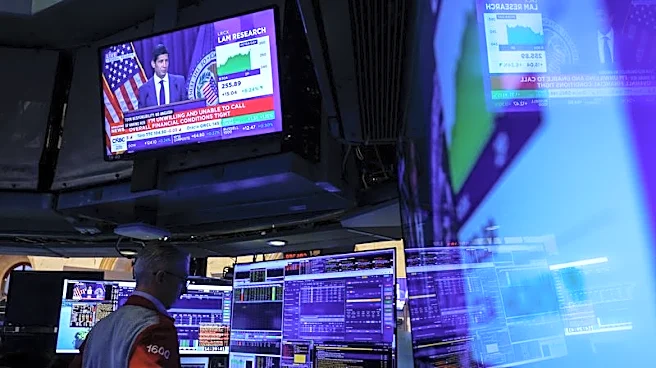
The Nasdaq-100 index briefly dipped into a technical correction on October 30, 2026, falling more than 10% from its record high before recovering to close 9.1% below the record. The index closed at 28,384.85, after hitting an intraday low of 28,093.24.
This market turbulence was largely driven by a significant sell-off in semiconductor stocks, with the Philadelphia Semiconductor Index experiencing its worst day since June 23, falling 7.2% and losing 15.4% for October. NVIDIA (NASDAQ:NVDA), a major holding in the Invesco QQQ Trust (NASDAQ:QQQ), saw its shares drop 4.2%, reducing its market value to $4.94 trillion. Intel (NASDAQ:INTC) also contributed to the downturn, with its stock plummeting 28.6% after providing a weak fourth-quarter outlook. This widespread selling in chip stocks has led some analysts to suggest that the 'AI trade' is moving from a phase of 'hopes and dreams' to one that demands tangible results.
Why It's Important?
The brief correction in the Nasdaq-100 and the significant decline in semiconductor stocks signal a growing skepticism among investors regarding the immediate returns on massive investments in AI data centers. This shift in investor sentiment could have profound implications for the U.S. technology sector, particularly for companies heavily invested in AI infrastructure and chip manufacturing. The market is now demanding concrete evidence of profitability and measurable business outcomes from AI initiatives, rather than just growth potential. This could lead to a re-evaluation of valuations for many AI-focused companies and a more cautious approach to capital allocation. The rotation of funds towards more stable mega-cap companies, as evidenced by Apple reclaiming the top market value spot, suggests a flight to perceived safety amidst the uncertainty in the AI market.
What's Next?
The coming weeks will be critical for the tech market. Key events include Apple's anticipated earnings report after the close on November 2, the midterm elections on November 3, the October jobs report on November 6, and NVIDIA's earnings report in mid-November. These events will provide further clarity on corporate performance and broader economic conditions, which could either stabilize the market or exacerbate the current downturn. Investors will be closely monitoring whether the Nasdaq-100 can maintain its position above the correction threshold and if the 'show me' phase of the AI trade yields positive results. The performance of other major tech companies, particularly those with significant AI exposure, will also be under intense scrutiny.
Beyond the Headlines
The current market volatility in the tech sector, particularly concerning AI stocks, highlights a deeper tension between technological innovation and financial realities. While AI promises transformative changes, the path to widespread profitability and return on investment is proving to be complex and challenging. This situation could lead to a more disciplined approach to AI development and deployment, with a greater emphasis on practical applications and demonstrable value. It also underscores the inherent risks associated with speculative investments in emerging technologies. The market's demand for 'show me' results could foster a more mature and sustainable AI ecosystem in the long run, but it may also lead to consolidation and increased scrutiny for companies that fail to deliver on their promises.